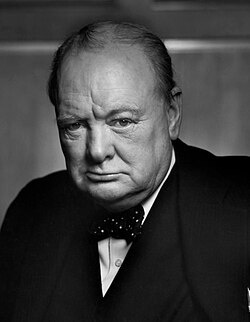
Winston Churchill
Sir Winston Leonard Spencer Churchill was a British statesman and Prime Minister of the United Kingdom from 1940 to 1945, during the Second World War, and again from 1951 to 1955.
Why Winston Churchill Appears in the Documents
Winston Churchill is mentioned in 30 documents within the Epstein file corpus, consisting of 22 articles, 4 speechs, 2 emails, 1 data, 1 reference, originating from the House Oversight Committee.
These documents include address book or contact list entries, media articles, emails. The presence of Winston Churchill's name in these specific document types reflects the scope of the released corpus, which contains a wide range of records from legal proceedings, investigations, and media coverage.
Disclaimer: Appearing in the Epstein document corpus does not imply wrongdoing, guilt, or any form of association with criminal activity. Many public figures are mentioned incidentally in these documents due to the broad scope of the released materials.
Documents (30)
Epst_9780451494566_2p_all_r1.z.indd
Source: House Oversight Committee
The Snowden Affair: A Spy Story in Six Parts
Source: House Oversight Committee
The Snowden Affair: A Spy Story in Six Parts
Source: House Oversight Committee
Geopolitical Articles Digest – August 2011
This six-article bundle from August 2011 surveys how leadership psychology, international intervention, and long-running regional conflicts shape the Middle East and U.S. policy: Scientific American analyzes Muammar Qadhafi’s possible detachment from reality and narcissism; The Financial Times argues that Libya intervention proved the sceptics wrong and offers hard-won lessons; Foreign Policy reports on Sinai’s Bedouin-led unrest and its impact on post-Mubarak Egypt; The National Interest critiques Obama’s foreign policy and lays out looming strategic choices involving Pakistan, China, and Russia; The New York Times reviews Dick Cheney’s memoir and his take on Syria and other thorny issues; and Ma’an News Agency provides a historical overview of Palestine and the statehood question, including UN pathways and international law.
Source: House Oversight Committee
Geopolitical Articles Digest – August 2011
This six-article bundle from August 2011 surveys how leadership psychology, international intervention, and long-running regional conflicts shape the Middle East and U.S. policy: Scientific American analyzes Muammar Qadhafi’s possible detachment from reality and narcissism; The Financial Times argues that Libya intervention proved the sceptics wrong and offers hard-won lessons; Foreign Policy reports on Sinai’s Bedouin-led unrest and its impact on post-Mubarak Egypt; The National Interest critiques Obama’s foreign policy and lays out looming strategic choices involving Pakistan, China, and Russia; The New York Times reviews Dick Cheney’s memoir and his take on Syria and other thorny issues; and Ma’an News Agency provides a historical overview of Palestine and the statehood question, including UN pathways and international law.
Source: House Oversight Committee
Geopolitical Articles Digest – August 2011
This six-article bundle from August 2011 surveys how leadership psychology, international intervention, and long-running regional conflicts shape the Middle East and U.S. policy: Scientific American analyzes Muammar Qadhafi’s possible detachment from reality and narcissism; The Financial Times argues that Libya intervention proved the sceptics wrong and offers hard-won lessons; Foreign Policy reports on Sinai’s Bedouin-led unrest and its impact on post-Mubarak Egypt; The National Interest critiques Obama’s foreign policy and lays out looming strategic choices involving Pakistan, China, and Russia; The New York Times reviews Dick Cheney’s memoir and his take on Syria and other thorny issues; and Ma’an News Agency provides a historical overview of Palestine and the statehood question, including UN pathways and international law.
Source: House Oversight Committee
EB Draft Ch1-25
Source: House Oversight Committee
Fire and Fury
Source: House Oversight Committee
Fire and Fury
Source: House Oversight Committee
The Search for Peace in the Arab–Israeli Conflict: A Compendium of Documents and Analysis
Oxford University Press's The Search for Peace in the Arab–Israeli Conflict is a sourcebook of documents and analysis that charts the long, often jagged pursuit of peace from the Sykes–Picot era to the 2014 Gaza crisis. Edited by Terje Rød-Larsen, Nur Laiq, and Fabrice Aidan, it assembles key peace agreements, proposals, UN and regional records, and domestic texts across five thematic parts, enhanced by maps and a guiding chronology. Its centerpiece, The Crooked Course, explains how gradualist and totalist approaches shaped negotiations—from Oslo and Madrid to the Road Map and the Quartet—highlighting both breakthroughs and dead ends, and offering a rigorous reference for scholars, policymakers, and students seeking to understand what works, what fails, and why.
Source: House Oversight Committee
Arab Spring and Middle East Analysis (2011 compilation of six articles)
Taken together, these six mid-2011 articles survey a world undergoing rapid transformation: the Arab Spring has unsettled regimes from Tunisia to Bahrain and forced a reassessment of Western credibility and engagement in the region; Israel and the Palestinian question remain a volatile hinge in regional politics, while Islamist movements like Ennahda and the Muslim Brotherhood face new multi‑party realities; Al Qaeda’s leadership succession under Zawahiri signals a renewed but precarious Islamist threat; the United States wrestles with how much foreign policy still matters to an economy-focused electorate; Europe confronts a faltering eurozone, rising social unrest, and the limits of its leadership in a shifting global order; and a lengthy analysis of potential conflict with Iran underscores the extensive military, diplomatic, economic and social spillovers of a war, the uncertainties of escalation, and the daunting task of planning for a protracted, multi-domain confrontation.
Source: House Oversight Committee
March 29, 2011 – Collection of international affairs opinion pieces (Syria, Libya, Egypt)
Eight essays from major outlets written in late March 2011 examine how the Arab Spring is remaking the Middle East—from Egypt and Libya to Syria—while challenging Western leadership, highlighting the fragility of interventionist doctrine, the realignment of regional powers, and the emergence of rising economies reshaping global politics, all set against ongoing struggles over democracy, governance, and the Israeli-Palestinian conflict.
Source: House Oversight Committee
TSS1211
Source: House Oversight Committee
TSS1211
Source: House Oversight Committee
TSS1211
Source: House Oversight Committee
End of Mideast Wholesale; Is This the End of the Assad Dynasty?; Mohamed ElBaradei, the Inspector; Hillary Clinton - Woman of the World
This collection juxtaposes 2011’s Middle East upheavals with the force and limits of Western diplomacy: Thomas Friedman argues that the era of Middle East wholesale stability is ending, forcing Israel, the Arab monarchies, and Egypt’s political actors to pay a higher “retail” price for peace and reform; Patrick Seale analyzes Bashar al-Assad’s Syria as a long‑standing autocracy pressured by demands for genuine reform and the risk of internal collapse; Leslie Gelb reviews Mohamed ElBaradei’s Age of Deception, advocating diplomacy and stronger international oversight to curb nuclear proliferation while warning that real progress requires major-power engagement; and Jonathan Alter profiles Hillary Clinton as secretary of state steering a 3‑D foreign policy—combining diplomacy, development, and coalition action—through the Libya intervention and a crisis‑ridden, WikiLeaks‑shadowed era, with her legacy tied to governing in a volatile region.
Source: House Oversight Committee
Address on Middle East Security and Regional Peace
In this 2014 address, the speaker portrays the Middle East as a “perfect storm”—the Arab Spring’s aftermath, intra-Islamic conflict, and a world without a single geopolitical center—placing Israel at the center of existential threats from ISIS, Iran, and Hezbollah, but also at a unique strategic leverage point. He argues that Israel must act from a position of strength—militarily, economically, and diplomatically—while maintaining a moral high ground and close, trust-based ties with the United States. Cautioning against pessimism and complacency, he advocates blocking a nuclear Iran and pursuing a regional peace anchored by a two-state solution within a broader regional framework, potentially based on the Saudi proposal, even if achieved through interim steps. He warns that the gravest danger is a slide to a one-state reality and internal societal fracture, urging reforms in governance, the rule of law, and social cohesion, while prioritizing the younger generation. Ultimately, he calls for bold, principled leadership—Seizing opportunities as Ben-Gurion did—and translating vision into action through a sustainable regional agreement that secures Israel’s future.
Source: House Oversight Committee
Address on Middle East Security and Regional Peace
In this 2014 address, the speaker portrays the Middle East as a “perfect storm”—the Arab Spring’s aftermath, intra-Islamic conflict, and a world without a single geopolitical center—placing Israel at the center of existential threats from ISIS, Iran, and Hezbollah, but also at a unique strategic leverage point. He argues that Israel must act from a position of strength—militarily, economically, and diplomatically—while maintaining a moral high ground and close, trust-based ties with the United States. Cautioning against pessimism and complacency, he advocates blocking a nuclear Iran and pursuing a regional peace anchored by a two-state solution within a broader regional framework, potentially based on the Saudi proposal, even if achieved through interim steps. He warns that the gravest danger is a slide to a one-state reality and internal societal fracture, urging reforms in governance, the rule of law, and social cohesion, while prioritizing the younger generation. Ultimately, he calls for bold, principled leadership—Seizing opportunities as Ben-Gurion did—and translating vision into action through a sustainable regional agreement that secures Israel’s future.
Source: House Oversight Committee
Paul Keating explains as never before
An extended interview with Paul Keating portrays him as arguing that leadership must be guided by a higher calling and a synthesis of beauty and reason, lamenting that Labor lacks an overarching narrative and calling for an Australia‑in‑Transition framework focused on productivity, savings, education and hi‑tech, cultural transformation, and closer East Asian ties—including a movement toward becoming a republic—to navigate a world increasingly shaped by China, with the US and Europe making strategic missteps that threaten global stability.
Source: House Oversight Committee
Paul Keating: After Words interview and related commentary
The document is a set of emails and newspaper excerpts centered on Paul Keating’s book After Words, a speeches collection in which Keating argues that creativity and reason—guided by an inner sense of purpose—should steer leadership and national strategy. It includes Katherine Keating forwarding a forward to her father’s book, and two Australian articles and an interview that sketch Keating’s philosophy of “Australia in Transition,” critique post–Cold War U.S. and European policy, assess China’s rise, and advocate cultural transformation and stronger East Asian ties as Australia’s path to future prosperity.
Source: House Oversight Committee
Paul Keating explains as never before
An extended interview with Paul Keating portrays him as arguing that leadership must be guided by a higher calling and a synthesis of beauty and reason, lamenting that Labor lacks an overarching narrative and calling for an Australia‑in‑Transition framework focused on productivity, savings, education and hi‑tech, cultural transformation, and closer East Asian ties—including a movement toward becoming a republic—to navigate a world increasingly shaped by China, with the US and Europe making strategic missteps that threaten global stability.
Source: House Oversight Committee
Israel Security and Regional Peace Strategy Speech (2014)
Against a backdrop of Arab upheaval, ISIS, Iran, and a geopolitically centerless world, the author argues that Israel remains the strongest regional power provided it combines military strength with prudent diplomacy and steadfast US backing. He stresses that Israel’s future hinges on maintaining its moral high ground, social cohesion, and economic vitality, even as it prepares for a prolonged struggle against radical terrorism. The core strategic path is to pursue a two-state solution within a broader regional framework—potentially anchored by Saudi proposals and a regional conference with moderate Arab states—supported by the international community and paired with a continued IDF edge. He cautions that regional instability stems from more than the Palestinian issue and warns against internal division and the slide toward a one-state outcome, urging bold leadership and long-term, imaginative statesmanship modeled on Israel’s great 20th-century leaders.
Source: House Oversight Committee
Israel Security and Regional Peace Strategy Speech (2014)
Against a backdrop of Arab upheaval, ISIS, Iran, and a geopolitically centerless world, the author argues that Israel remains the strongest regional power provided it combines military strength with prudent diplomacy and steadfast US backing. He stresses that Israel’s future hinges on maintaining its moral high ground, social cohesion, and economic vitality, even as it prepares for a prolonged struggle against radical terrorism. The core strategic path is to pursue a two-state solution within a broader regional framework—potentially anchored by Saudi proposals and a regional conference with moderate Arab states—supported by the international community and paired with a continued IDF edge. He cautions that regional instability stems from more than the Palestinian issue and warns against internal division and the slide toward a one-state outcome, urging bold leadership and long-term, imaginative statesmanship modeled on Israel’s great 20th-century leaders.
Source: House Oversight Committee
Creativity is central to our endeavours
Paul Keating's After Words collects his speeches to argue that creativity and the "inner command"—a Kantian sense of higher purpose—must guide leadership as much as policy briefings. In interviews, he lays out a cohesive vision for Australia’s future, urging a national story of "Australia in Transition," cultural transformation, and closer ties to East Asia, including republican reform to stay competitive in a China-led world. He critiques US and European missteps, champions liberal internationalism, and insists that progress comes from blending imagination—music, art, architecture—with reason, education, and productivity.
Source: House Oversight Committee
Paul Keating: After Words – interview and reflections
This document compiles emails and long excerpts about Paul Keating’s new book After Words and a companion Australian interview in which Keating argues that leadership should blend creativity, beauty, and intuition with reason, drawing on Kant’s notion of the inner self and an inner command to guide public life. He critiques the post–Cold War trajectory of the United States and Europe, foresees a 21st‑century order dominated by China, the US, and India, and advocates a cohesive Australian strategy—“Australia in Transition”—focused on reforming the economy, boosting savings, investing in hi‑tech and education, and strengthening East Asian ties, while making the case for Australia’s republic as essential to competing in Asia and avoiding the pitfalls of incrementalism.
Source: House Oversight Committee
Email exchange between Noam Chomsky and Jeffrey E. on vision, language, and geopolitics
This email exchange between Noam Chomsky and a colleague centers on cognitive science, arguing that vision and language operate under different fundamental principles: vision is an input system that crafts coherent images from sensory data, whereas language is an internal, modality-independent capacity—an internal knowledge system used to process input and to generate thoughts—making a direct, piggy‑back link between the two difficult; they discuss Marr’s program, the work of Shimon Ullman, and the notion that while the two domains may share insights, their core mechanisms differ enough that linking them remains a stumbling block, with references to a recent paper and reflections on how experience shapes development.
Source: House Oversight Committee
Paul Keating: After Words – interview and reflections
This document compiles emails and long excerpts about Paul Keating’s new book After Words and a companion Australian interview in which Keating argues that leadership should blend creativity, beauty, and intuition with reason, drawing on Kant’s notion of the inner self and an inner command to guide public life. He critiques the post–Cold War trajectory of the United States and Europe, foresees a 21st‑century order dominated by China, the US, and India, and advocates a cohesive Australian strategy—“Australia in Transition”—focused on reforming the economy, boosting savings, investing in hi‑tech and education, and strengthening East Asian ties, while making the case for Australia’s republic as essential to competing in Asia and avoiding the pitfalls of incrementalism.
Source: House Oversight Committee
Email exchange between Noam Chomsky and Jeffrey E. on vision, language, and geopolitics
This email exchange between Noam Chomsky and a colleague centers on cognitive science, arguing that vision and language operate under different fundamental principles: vision is an input system that crafts coherent images from sensory data, whereas language is an internal, modality-independent capacity—an internal knowledge system used to process input and to generate thoughts—making a direct, piggy‑back link between the two difficult; they discuss Marr’s program, the work of Shimon Ullman, and the notion that while the two domains may share insights, their core mechanisms differ enough that linking them remains a stumbling block, with references to a recent paper and reflections on how experience shapes development.
Source: House Oversight Committee
Brexit Statistics from Twitter (June 23, 2016)
Brexit Statistics is a Twitter-based sentiment snapshot from June 23, 2016, covering twelve hours (12 AM–11 PM CEST) and comprising roughly 302,000 tweets; among them about 157,000 were positive, 93,000 negative, and 52,000 neutral, reflecting a worldwide, multilingual Brexit discourse with real-time reactions to polls, forecasts, and political figures.
Source: House Oversight Committee
Keating Interview: Leadership, Australia in Transition, and the Global Order
Former Australian prime minister Paul Keating uses an expansive interview to argue that the 21st century requires a unifying national narrative and a cultural‑economic transition for Australia—anchored in creativity, savings, education, and a deeper pivot to East Asia—toward a republic and a more self‑reliant future. He critiques US and European leadership, links the 2008 crisis to global imbalances and policy missteps, praises Deng Xiaoping’s reform legacy, and forecast a 2050 world order led by China, the US, and India, urging Australia to adapt or fall behind. He also presses Labor to shed an insider, shortsighted culture and become the party of the new society, presenting a digestible framework—“Australia in Transition”—to unite reform with a compelling, widely understood story rather than incremental policy alone.
Source: House Oversight Committee