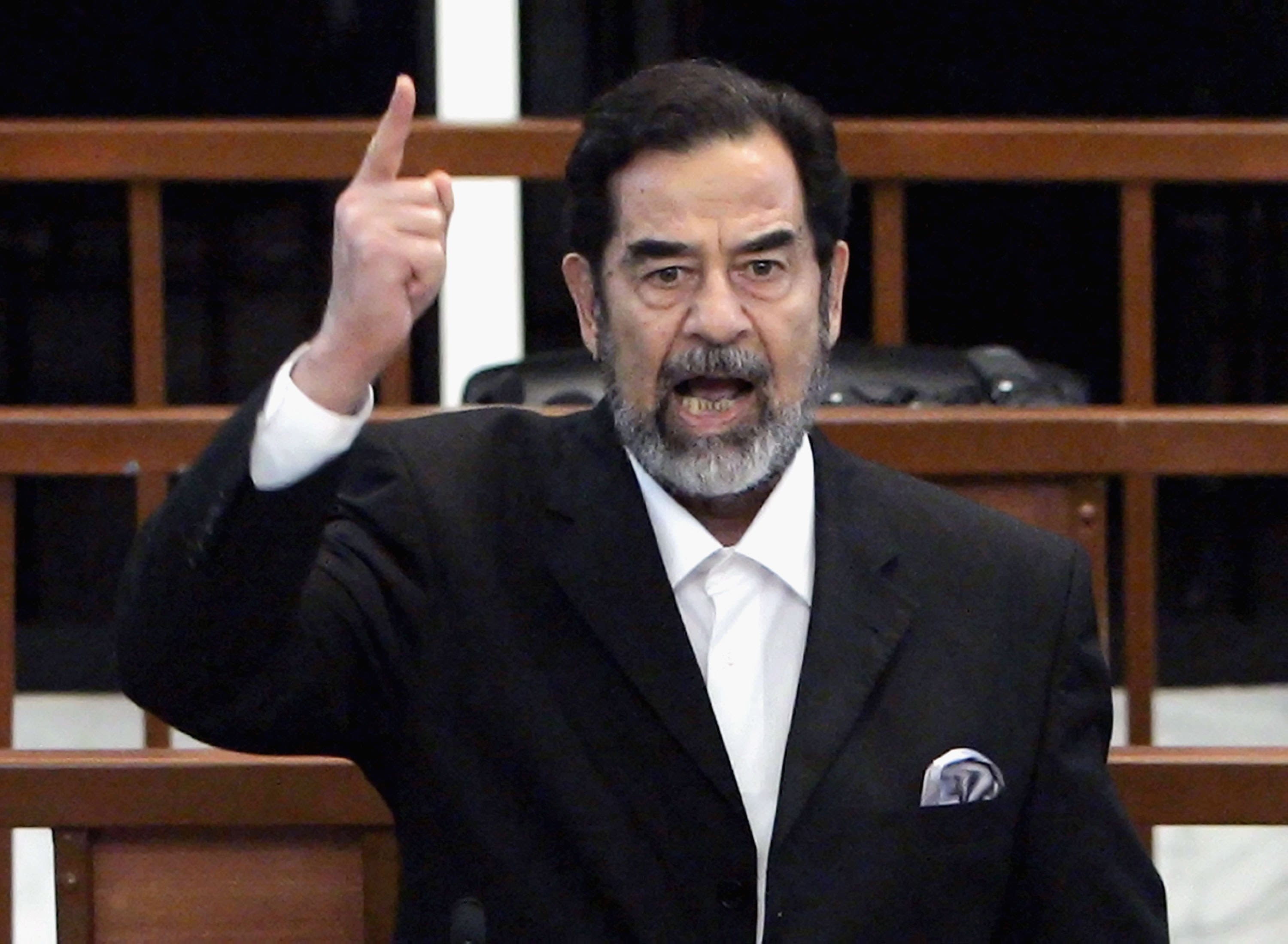
Saddam Hussein
Saddam Hussein Abd al-Majid al-Tikriti was the President of Iraq from 1979 to 2003. His authoritarian rule, wars with Iran and Kuwait, and eventual overthrow during the 2003 US-led invasion made him one of the most controversial figures of the 20th century.
Why Saddam Hussein Appears in the Documents
Saddam Hussein is mentioned in 80 documents within the Epstein file corpus, consisting of 62 articles, 9 emails, 4 memoirs, 2 analysiss, 2 memos, 1 reference, originating from the House Oversight Committee.
These documents include titles such as "Inside Job (2010) Film Review", "Inside Job documentary review and discussion", "John Humphrys: The Terrier of Today, in conversation with Justin Webb" among others. Saddam Hussein's name appears across these documents in various contexts. The document corpus contains a wide range of materials including media coverage, government records, and legal proceedings where many public figures are mentioned.
Disclaimer: Appearing in the Epstein document corpus does not imply wrongdoing, guilt, or any form of association with criminal activity. Many public figures are mentioned incidentally in these documents due to the broad scope of the released materials.
Documents (50)
Inside Job (2010) Film Review
Inside Job, Charles Ferguson’s 2010 documentary, traces the 2008 financial crisis to two decades of deregulation, risky derivatives, and the collusion of banks, rating agencies, and policymakers, presenting a sweeping, rigorously argued history from Reagan through Iceland. Through dozens of interviews, archival clips, and Matt Damon’s narration, it argues the disaster was a preventable outcome born of warped values, groupthink, and conflicts of interest across both political parties and the economics profession. Though some key players declined to participate and the film may leave viewers unsettled or angrier, it delivers a clear, well-supported case and a provocative call for meaningful reform.
Source: House Oversight Committee
Inside Job (2010) Film Review
Inside Job, Charles Ferguson’s 2010 documentary, traces the 2008 financial crisis to two decades of deregulation, risky derivatives, and the collusion of banks, rating agencies, and policymakers, presenting a sweeping, rigorously argued history from Reagan through Iceland. Through dozens of interviews, archival clips, and Matt Damon’s narration, it argues the disaster was a preventable outcome born of warped values, groupthink, and conflicts of interest across both political parties and the economics profession. Though some key players declined to participate and the film may leave viewers unsettled or angrier, it delivers a clear, well-supported case and a provocative call for meaningful reform.
Source: House Oversight Committee
Inside Job documentary review and discussion
Inside Job (2010) is a rigorously argued documentary by Charles Ferguson, hailed as a New York Times Critic’s Pick, that traces the 2008 financial crisis from deregulation and risky derivatives to the housing-market collapse and the perceived complicity of Wall Street, policymakers, and economists. Through dozens of interviews, archival clips, and Matt Damon’s narration, it makes a persuasive, morally forceful case that the system encouraged reckless behavior with scant accountability, ending with a blunt call for structural reform, even as some voices were absent and the film could have more fully explored the impact on ordinary people.
Source: House Oversight Committee
Inside Job documentary review and discussion
Inside Job (2010) is a rigorously argued documentary by Charles Ferguson, hailed as a New York Times Critic’s Pick, that traces the 2008 financial crisis from deregulation and risky derivatives to the housing-market collapse and the perceived complicity of Wall Street, policymakers, and economists. Through dozens of interviews, archival clips, and Matt Damon’s narration, it makes a persuasive, morally forceful case that the system encouraged reckless behavior with scant accountability, ending with a blunt call for structural reform, even as some voices were absent and the film could have more fully explored the impact on ordinary people.
Source: House Oversight Committee
John Humphrys: The Terrier of Today, in conversation with Justin Webb
Intelligence Squared presents John Humphrys: The Terrier of Today, in conversation with Justin Webb, an exclusive event at the Emmanuel Centre on Wednesday October 9 at 7pm, where the longtime BBC Radio 4 Today presenter—stepping down after 32 years and publishing a memoir—offers a revealing, no-holds-barred account of his career, sharing behind-the-scenes stories from defining interviews with politicians and celebrities to pivotal moments like the Gilligan Iraq dossier coverage and the Entwistle resignation, and offering his sharp views on the media’s role in politics.
Source: House Oversight Committee
John Humphrys: The Terrier of Today, in conversation with Justin Webb
Intelligence Squared presents John Humphrys: The Terrier of Today, in conversation with Justin Webb, an exclusive event at the Emmanuel Centre on Wednesday October 9 at 7pm, where the longtime BBC Radio 4 Today presenter—stepping down after 32 years and publishing a memoir—offers a revealing, no-holds-barred account of his career, sharing behind-the-scenes stories from defining interviews with politicians and celebrities to pivotal moments like the Gilligan Iraq dossier coverage and the Entwistle resignation, and offering his sharp views on the media’s role in politics.
Source: House Oversight Committee
Review: Inside Job (2010)
This forwarded email contains a New York Times Critics’ Pick review of the 2010 documentary Inside Job, which offers a rigorous, well-argued history of the 2008 financial crisis—from Reagan-era deregulation to the growth of complex derivatives—arguing that warped values, groupthink, and conflicts of interest among policymakers, academics, and bankers caused the meltdown; with extensive interviews and Matt Damon narrating, the film is praised for its clear, measured, morally forceful critique and its call for real reform, even as it can leave viewers dispirited.
Source: House Oversight Committee
Debate on Cultural Evolution, Psychopathy, and Evolutionary Genetics
This is a heated, cross-experimental debate about what really shapes human behavior, cooperation, and conflict, arguing against a purely cultural-evolution narrative and insisting that genetic and biological processes—such as parasite pressures, kin selection, and psychopathic tendencies in leaders—remain central; the author challenges the idea that culture provides a discrete, inheritable unit of variation, criticizes cultural explanations as insufficient for explaining phenomena like language diversity, social norms, and honor killings, and presses for an integrated view that combines genetic, developmental, and cultural factors, illustrated by references to empirical work on youth psychopathy and provocative real-world examples from political and historical leaders.
Source: House Oversight Committee
Debate on Cultural Evolution, Psychopathy, and Evolutionary Genetics
This is a heated, cross-experimental debate about what really shapes human behavior, cooperation, and conflict, arguing against a purely cultural-evolution narrative and insisting that genetic and biological processes—such as parasite pressures, kin selection, and psychopathic tendencies in leaders—remain central; the author challenges the idea that culture provides a discrete, inheritable unit of variation, criticizes cultural explanations as insufficient for explaining phenomena like language diversity, social norms, and honor killings, and presses for an integrated view that combines genetic, developmental, and cultural factors, illustrated by references to empirical work on youth psychopathy and provocative real-world examples from political and historical leaders.
Source: House Oversight Committee
Inside Job documentary review
A brisk, rigorously argued documentary, Inside Job traces the 2008 financial crisis from the deregulation of the 1980s through the housing bubble and the rise of risky derivatives, showing how Wall Street, politicians, and even some academics collided in a system that rewarded reckless speculation and went largely unpunished; guided by dozens of interviews and archival footage and narrated by Matt Damon, the film indicts both political parties and the financial industry, delivering a powerful, data-driven plea for accountability and reform.
Source: House Oversight Committee
John Humphrys: The Terrier of Today – Event Announcement
Intelligence Squared presents John Humphrys: The Terrier of Today, a candid, behind-the-scenes conversation with Justin Webb at the Emmanuel Centre on Wednesday 9 October at 7 PM, where the veteran BBC Radio 4 Today host—stepping down after 32 years and publishing a memoir—will share untold stories from his career, offer sharp takes on the media’s role in politics, and discuss pivotal moments such as the Gilligan dossier interview, the David Kelly affair, and George Entwistle’s resignation.
Source: House Oversight Committee
Terrorism - Metrojet and Paris Mark Externalization of ISIS Threat
This memo warns that ISIS has eclipsed Al Qaeda in capability, financing, and global reach, as demonstrated by the Metrojet bombing, the Paris attacks, and Beirut violence, signaling a likely uptick in spectacular attacks and intensified, broader engagement against ISIS in Iraq/Syria and Europe; it predicts European and U.S. security authorities will adopt more intrusive measures toward Muslim communities and refugees, European refugee policies will tighten amid rising right-wing pressures, and counterterrorism efforts will focus on aviation security and American interests overseas (including embassies and bases), even as there are no clear signs of direct attacks on the United States itself.
Source: House Oversight Committee
John Humphrys: The Terrier of Today – Event Announcement
Intelligence Squared presents John Humphrys: The Terrier of Today, a candid, behind-the-scenes conversation with Justin Webb at the Emmanuel Centre on Wednesday 9 October at 7 PM, where the veteran BBC Radio 4 Today host—stepping down after 32 years and publishing a memoir—will share untold stories from his career, offer sharp takes on the media’s role in politics, and discuss pivotal moments such as the Gilligan dossier interview, the David Kelly affair, and George Entwistle’s resignation.
Source: House Oversight Committee
Terrorism - Metrojet and Paris Mark Externalization of ISIS Threat
This memo warns that ISIS has eclipsed Al Qaeda in capability, financing, and global reach, as demonstrated by the Metrojet bombing, the Paris attacks, and Beirut violence, signaling a likely uptick in spectacular attacks and intensified, broader engagement against ISIS in Iraq/Syria and Europe; it predicts European and U.S. security authorities will adopt more intrusive measures toward Muslim communities and refugees, European refugee policies will tighten amid rising right-wing pressures, and counterterrorism efforts will focus on aviation security and American interests overseas (including embassies and bases), even as there are no clear signs of direct attacks on the United States itself.
Source: House Oversight Committee
Inside Job documentary review
A brisk, rigorously argued documentary, Inside Job traces the 2008 financial crisis from the deregulation of the 1980s through the housing bubble and the rise of risky derivatives, showing how Wall Street, politicians, and even some academics collided in a system that rewarded reckless speculation and went largely unpunished; guided by dozens of interviews and archival footage and narrated by Matt Damon, the film indicts both political parties and the financial industry, delivering a powerful, data-driven plea for accountability and reform.
Source: House Oversight Committee
Policy Analyses on Iran Nuclear Issue, Sanctions, and Global Governance (2013)
This collection of policy essays from February 2013 surveys the volatile landscape of nuclear diplomacy and global governance, arguing that blunt sanctions and “final deal” rhetoric are unlikely to resolve Iran’s or North Korea’s programs and that a measured, incremental approach—grounded in verifiable steps, credible deterrence, and multilateral engagement—offers a better path, while urging reform of international institutions to reflect a rising Asia and a shifting world order; it also presents a sobering portrait of the Israel–Palestine conflict, showing growing Palestinian fatigue with the peace process and rising support for resistance, underscoring the urgency of renewed, realistic diplomacy.
Source: House Oversight Committee
Iran Nuclear Program and International Sanctions: Policy Essays
Across this 2013 collection, policy voices argue that Iran and North Korea’s nuclear programs demand incremental, verifiable diplomacy within a strengthened multilateral framework—avoiding take-it-or-leave-it bargains or purely punitive sanctions—and that credible deterrence, paired with calibrated incentives, offers the best chance to curb proliferation without triggering wider conflict. The set also weighs the limits of sanctions, the prospects and perils of regime change, and the need to reform global governance, while a Palestinian-focused piece highlights rising public frustration with the peace process and the fragility of a two-state solution, underscoring the imperative for pragmatic diplomacy and sustained international coordination.
Source: House Oversight Committee
Iran Nuclear Program and International Sanctions: Policy Essays
Across this 2013 collection, policy voices argue that Iran and North Korea’s nuclear programs demand incremental, verifiable diplomacy within a strengthened multilateral framework—avoiding take-it-or-leave-it bargains or purely punitive sanctions—and that credible deterrence, paired with calibrated incentives, offers the best chance to curb proliferation without triggering wider conflict. The set also weighs the limits of sanctions, the prospects and perils of regime change, and the need to reform global governance, while a Palestinian-focused piece highlights rising public frustration with the peace process and the fragility of a two-state solution, underscoring the imperative for pragmatic diplomacy and sustained international coordination.
Source: House Oversight Committee
Iran Nuclear Program and International Sanctions: Policy Essays
Across this 2013 collection, policy voices argue that Iran and North Korea’s nuclear programs demand incremental, verifiable diplomacy within a strengthened multilateral framework—avoiding take-it-or-leave-it bargains or purely punitive sanctions—and that credible deterrence, paired with calibrated incentives, offers the best chance to curb proliferation without triggering wider conflict. The set also weighs the limits of sanctions, the prospects and perils of regime change, and the need to reform global governance, while a Palestinian-focused piece highlights rising public frustration with the peace process and the fragility of a two-state solution, underscoring the imperative for pragmatic diplomacy and sustained international coordination.
Source: House Oversight Committee
EB Draft Ch1-25
Source: House Oversight Committee
EB Draft Ch1-25
Source: House Oversight Committee
EB Draft Ch1-25
Source: House Oversight Committee
EB Draft Ch1-25
Source: House Oversight Committee
EB Draft Ch1-25
Source: House Oversight Committee
EB Draft Ch1-25
Source: House Oversight Committee
EB Draft Ch1-25
Source: House Oversight Committee
EB Draft Ch1-25
Source: House Oversight Committee
EB Draft Ch1-25
Source: House Oversight Committee
EB Draft Ch1-25
Source: House Oversight Committee
EB Draft Ch1-25
Source: House Oversight Committee
EB Draft Ch1-25
Source: House Oversight Committee
EB Draft Ch1-25
Source: House Oversight Committee
EB Draft Ch1-25
Source: House Oversight Committee
EB Draft Ch1-25
Source: House Oversight Committee
EB Draft Ch1-25
Source: House Oversight Committee
EB Draft Ch1-25
Source: House Oversight Committee
Geopolitical Articles Digest – August 2011
This six-article bundle from August 2011 surveys how leadership psychology, international intervention, and long-running regional conflicts shape the Middle East and U.S. policy: Scientific American analyzes Muammar Qadhafi’s possible detachment from reality and narcissism; The Financial Times argues that Libya intervention proved the sceptics wrong and offers hard-won lessons; Foreign Policy reports on Sinai’s Bedouin-led unrest and its impact on post-Mubarak Egypt; The National Interest critiques Obama’s foreign policy and lays out looming strategic choices involving Pakistan, China, and Russia; The New York Times reviews Dick Cheney’s memoir and his take on Syria and other thorny issues; and Ma’an News Agency provides a historical overview of Palestine and the statehood question, including UN pathways and international law.
Source: House Oversight Committee
Geopolitical Articles Digest – August 2011
This six-article bundle from August 2011 surveys how leadership psychology, international intervention, and long-running regional conflicts shape the Middle East and U.S. policy: Scientific American analyzes Muammar Qadhafi’s possible detachment from reality and narcissism; The Financial Times argues that Libya intervention proved the sceptics wrong and offers hard-won lessons; Foreign Policy reports on Sinai’s Bedouin-led unrest and its impact on post-Mubarak Egypt; The National Interest critiques Obama’s foreign policy and lays out looming strategic choices involving Pakistan, China, and Russia; The New York Times reviews Dick Cheney’s memoir and his take on Syria and other thorny issues; and Ma’an News Agency provides a historical overview of Palestine and the statehood question, including UN pathways and international law.
Source: House Oversight Committee
Geopolitical Articles Digest – August 2011
This six-article bundle from August 2011 surveys how leadership psychology, international intervention, and long-running regional conflicts shape the Middle East and U.S. policy: Scientific American analyzes Muammar Qadhafi’s possible detachment from reality and narcissism; The Financial Times argues that Libya intervention proved the sceptics wrong and offers hard-won lessons; Foreign Policy reports on Sinai’s Bedouin-led unrest and its impact on post-Mubarak Egypt; The National Interest critiques Obama’s foreign policy and lays out looming strategic choices involving Pakistan, China, and Russia; The New York Times reviews Dick Cheney’s memoir and his take on Syria and other thorny issues; and Ma’an News Agency provides a historical overview of Palestine and the statehood question, including UN pathways and international law.
Source: House Oversight Committee
EB Draft Ch1-25
Source: House Oversight Committee
EB Draft Ch1-25
Source: House Oversight Committee
EB Draft Ch1-25
Source: House Oversight Committee
EB Draft Ch1-25
Source: House Oversight Committee
EB Draft Ch1-25
Source: House Oversight Committee
EB Draft Ch1-25
Source: House Oversight Committee
EB Draft Ch1-25
Source: House Oversight Committee
EB Draft Ch1-25
Source: House Oversight Committee
EB Draft Ch1-25
Source: House Oversight Committee
EB Draft Ch1-25
Source: House Oversight Committee
EB Draft Ch1-25
Source: House Oversight Committee