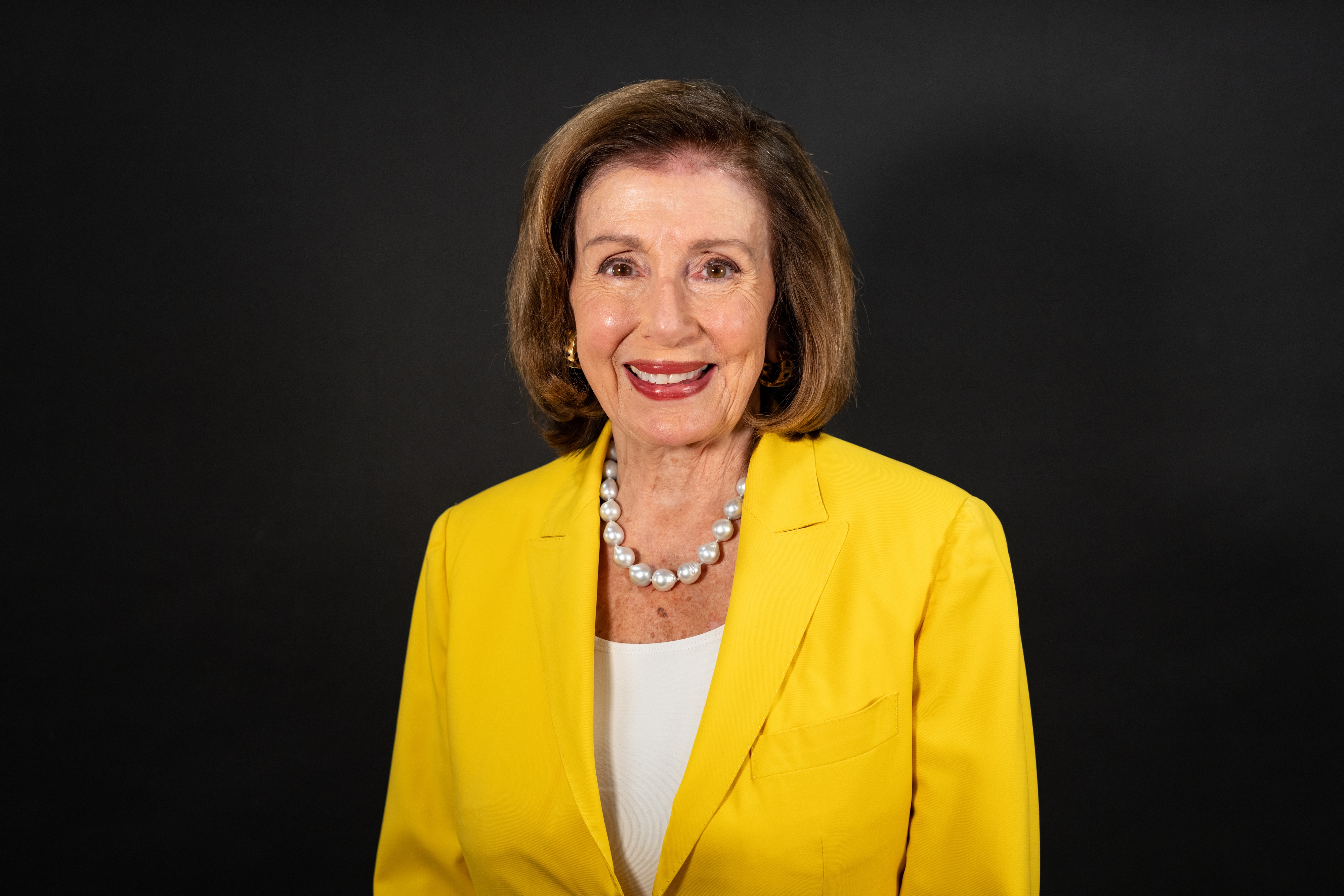
Nancy Pelosi
Nancy Patricia Pelosi is an American politician who served as the 52nd Speaker of the United States House of Representatives from 2007 to 2011 and again from 2019 to 2023.
Why Nancy Pelosi Appears in the Documents
Nancy Pelosi is mentioned in 29 documents within the Epstein file corpus, consisting of 10 articles, 9 emails, 4 chats, 2 datas, 1 book, 1 calendar, 1 list, 1 opinion, originating from the House Oversight Committee.
These documents include titles such as "When the Muzzle Comes Off", "J.P. Morgan Eye on the Market: Dire Straits (Feb 27, 2012)", "Siege: Trump Under Fire" among others. Nancy Pelosi's name appears across these documents in various contexts. The document corpus contains a wide range of materials including media coverage, government records, and legal proceedings where many public figures are mentioned.
Disclaimer: Appearing in the Epstein document corpus does not imply wrongdoing, guilt, or any form of association with criminal activity. Many public figures are mentioned incidentally in these documents due to the broad scope of the released materials.
Documents (29)
When the Muzzle Comes Off
Rebecca Traister argues that the #MeToo era is reshaping politics by forcing the nation to listen to women’s experiences of sexual assault and harassment—from Christine Blasey Ford and Deborah Ramirez to Amber Wyatt—revealing how power silences female voices, linking personal harm to broader systems of domination, and expanding what is acceptable to discuss, so that the act of telling and hearing these stories becomes a potent political force even when legal or political outcomes remain uncertain.
Source: House Oversight Committee
When the Muzzle Comes Off
Rebecca Traister argues that the #MeToo era is reshaping politics by forcing the nation to listen to women’s experiences of sexual assault and harassment—from Christine Blasey Ford and Deborah Ramirez to Amber Wyatt—revealing how power silences female voices, linking personal harm to broader systems of domination, and expanding what is acceptable to discuss, so that the act of telling and hearing these stories becomes a potent political force even when legal or political outcomes remain uncertain.
Source: House Oversight Committee
J.P. Morgan Eye on the Market: Dire Straits (Feb 27, 2012)
J.P. Morgan’s Eye on the Market (Feb. 27, 2012) argues that near‑term oil fundamentals may allow a modest inventory build, but the Iran crisis poses a binary risk that could tighten markets and push gasoline prices higher if a military action occurs. With the Strait of Hormuz handling about 20% of global oil and Iran’s Fordow facility complicating the nuclear debate, analysts estimate that a strike could lift prices by roughly $20–$30 per barrel, aided by sanctions, central‑bank reflation, and rising growth expectations even as OECD demand softens. The note also situates this within a broader macro backdrop of a recovering US economy but weaker Europe, critiques the idea that speculators alone drive spikes, and provocatively asks how much wind or natural gas would be needed to replace imported oil, highlighting the policy and infrastructure hurdles to energy independence and the need to factor geopolitical risk into portfolios.
Source: House Oversight Committee
J.P. Morgan Eye on the Market: Dire Straits (Feb 27, 2012)
J.P. Morgan’s Eye on the Market (Feb. 27, 2012) argues that near‑term oil fundamentals may allow a modest inventory build, but the Iran crisis poses a binary risk that could tighten markets and push gasoline prices higher if a military action occurs. With the Strait of Hormuz handling about 20% of global oil and Iran’s Fordow facility complicating the nuclear debate, analysts estimate that a strike could lift prices by roughly $20–$30 per barrel, aided by sanctions, central‑bank reflation, and rising growth expectations even as OECD demand softens. The note also situates this within a broader macro backdrop of a recovering US economy but weaker Europe, critiques the idea that speculators alone drive spikes, and provocatively asks how much wind or natural gas would be needed to replace imported oil, highlighting the policy and infrastructure hurdles to energy independence and the need to factor geopolitical risk into portfolios.
Source: House Oversight Committee
Siege: Trump Under Fire
Siege provides a real-time, inside-the-White-House portrait of Donald Trump in early 2018 as the Mueller Russia investigation tightens and a chaotic presidency buckles under legal peril and relentless infighting. It tracks a cast of Trump aides—Dowd, Cobb, and Sekulow on the legal side; Hicks, Porter, Kushner, and Bannon in the personal and political sphere—whose loyalty, ambitions, and improvisations collide with the president’s demand for “solutions” and disdain for constraint. Wolff also exposes the widening rift between the White House and the Justice Department, as high-stakes investigations, subpoenas, and the threat of firing officials threaten to pull the administration apart. Against this backdrop, the budget battles and the symbolic fight over the Wall reveal how loyalty, power, and perception—more than policy—will determine Trump’s fate.
Source: House Oversight Committee
Siege: Trump Under Fire
Siege provides a real-time, inside-the-White-House portrait of Donald Trump in early 2018 as the Mueller Russia investigation tightens and a chaotic presidency buckles under legal peril and relentless infighting. It tracks a cast of Trump aides—Dowd, Cobb, and Sekulow on the legal side; Hicks, Porter, Kushner, and Bannon in the personal and political sphere—whose loyalty, ambitions, and improvisations collide with the president’s demand for “solutions” and disdain for constraint. Wolff also exposes the widening rift between the White House and the Justice Department, as high-stakes investigations, subpoenas, and the threat of firing officials threaten to pull the administration apart. Against this backdrop, the budget battles and the symbolic fight over the Wall reveal how loyalty, power, and perception—more than policy—will determine Trump’s fate.
Source: House Oversight Committee
Fire and Fury
Source: House Oversight Committee
Fire and Fury
Source: House Oversight Committee
iMessage chat transcript about House Oversight (2018)
This iMessage archive from 2018 captures a dialogue between user jee and an associate (e:jeeitunes@gmail.com) coordinating a film trailer project, including scheduling and logistics, brainstorming content rooted in current political topics (Kavanaugh hearing, Pelosi controversy, caravan), planning a sequence tied to Paris during fashion week, and coordinating with an editor, all interspersed with casual banter and occasional crude remarks.
Source: House Oversight Committee
iMessage chat transcript about House Oversight (2018)
This iMessage archive from 2018 captures a dialogue between user jee and an associate (e:jeeitunes@gmail.com) coordinating a film trailer project, including scheduling and logistics, brainstorming content rooted in current political topics (Kavanaugh hearing, Pelosi controversy, caravan), planning a sequence tied to Paris during fashion week, and coordinating with an editor, all interspersed with casual banter and occasional crude remarks.
Source: House Oversight Committee
End of Mideast Wholesale; Is This the End of the Assad Dynasty?; Mohamed ElBaradei, the Inspector; Hillary Clinton - Woman of the World
This collection juxtaposes 2011’s Middle East upheavals with the force and limits of Western diplomacy: Thomas Friedman argues that the era of Middle East wholesale stability is ending, forcing Israel, the Arab monarchies, and Egypt’s political actors to pay a higher “retail” price for peace and reform; Patrick Seale analyzes Bashar al-Assad’s Syria as a long‑standing autocracy pressured by demands for genuine reform and the risk of internal collapse; Leslie Gelb reviews Mohamed ElBaradei’s Age of Deception, advocating diplomacy and stronger international oversight to curb nuclear proliferation while warning that real progress requires major-power engagement; and Jonathan Alter profiles Hillary Clinton as secretary of state steering a 3‑D foreign policy—combining diplomacy, development, and coalition action—through the Libya intervention and a crisis‑ridden, WikiLeaks‑shadowed era, with her legacy tied to governing in a volatile region.
Source: House Oversight Committee
Palmer Report updated - 03/24/2019
Palmer Report's 03/24/2019 edition compiles a high-priority briefing on the Trump–Mueller saga, weaving together Pelosi’s strategic moves and reactions to the Mueller investigation, clues about SDNY indictments and Mueller handoffs to multiple prosecutors, and ongoing analysis of Barr’s role and the evolving status of the Mueller inquiry.
Source: House Oversight Committee
Palmer Report updated - 03/24/2019
Palmer Report's 03/24/2019 edition compiles a high-priority briefing on the Trump–Mueller saga, weaving together Pelosi’s strategic moves and reactions to the Mueller investigation, clues about SDNY indictments and Mueller handoffs to multiple prosecutors, and ongoing analysis of Barr’s role and the evolving status of the Mueller inquiry.
Source: House Oversight Committee
Palmer Report updated - 03/24/2019
Palmer Report's 03/24/2019 edition compiles a high-priority briefing on the Trump–Mueller saga, weaving together Pelosi’s strategic moves and reactions to the Mueller investigation, clues about SDNY indictments and Mueller handoffs to multiple prosecutors, and ongoing analysis of Barr’s role and the evolving status of the Mueller inquiry.
Source: House Oversight Committee
Free Growth and Other Surprises
Gordon Getty’s Free Growth and Other Surprises argues that genuine economic growth comes not from thrift or traditional investment incentives, but from “free growth”—driven by productivity gains and the generation-to-generation transfer of total capital (human plus physical). He introduces the Y rule and the pay rule, reframes output as growth plus cash flow, and argues that human depreciation is expected to be recovered in pay even as depreciation itself rises over time. Drawing on Mill, Petty, and a new simultaneous rates method tested against market-valued capital data from Piketty and Zucman (and stock-market data), he maintains that growth at the macro scale has largely been a matter of free growth rather than savings-driven acceleration. The book then lays out sweeping policy reform: integrate human capital into national accounts, shift money toward real (inflation-adjusted) dollars, end the corporate double tax, tax capital gains like ordinary income, and split banks into deposit and lending entities so an omnibus fund can manage liquidity with low-cost derivatives. Interlacing biology and economics through Hamilton’s rule and bioeconomics, Getty frames tastes and investments as evolving under the biological imperative of lineage survival, offering a data-driven, history-grounded blueprint for a more resilient, innovation-driven economy.
Source: House Oversight Committee
iMessage chat log involving House Oversight and political commentary (2018)
This is a September 2018 iMessage archive from a group labeled “HOUSE OVERSIGHT,” capturing a long-running private dialogue between user “jee” and collaborators that blends sharp geopolitical and economic analysis with media strategy and logistical planning—discussing Trump and Obama, foreign influence and FARA/transparency concerns, drafting talking points for an economist-focused event, sharing editor quotes, and coordinating interviews and travel to New York, Paris, Rome, and beyond.
Source: House Oversight Committee
iMessage chat log involving House Oversight and political commentary (2018)
This is a September 2018 iMessage archive from a group labeled “HOUSE OVERSIGHT,” capturing a long-running private dialogue between user “jee” and collaborators that blends sharp geopolitical and economic analysis with media strategy and logistical planning—discussing Trump and Obama, foreign influence and FARA/transparency concerns, drafting talking points for an economist-focused event, sharing editor quotes, and coordinating interviews and travel to New York, Paris, Rome, and beyond.
Source: House Oversight Committee
iMessage chat log involving House Oversight and political commentary (2018)
This is a September 2018 iMessage archive from a group labeled “HOUSE OVERSIGHT,” capturing a long-running private dialogue between user “jee” and collaborators that blends sharp geopolitical and economic analysis with media strategy and logistical planning—discussing Trump and Obama, foreign influence and FARA/transparency concerns, drafting talking points for an economist-focused event, sharing editor quotes, and coordinating interviews and travel to New York, Paris, Rome, and beyond.
Source: House Oversight Committee
Steve Bannon's clever idea to save the GOP from brutal midterms
Fareed Zakaria reports on Steve Bannon’s argument that the GOP should nationalize the 2018 midterms by making immigration and the border wall the defining issues, appealing to working-class voters—including some Sanders supporters—by framing the race as a clash between nationalists and globalists; while the strategy is politically clever and aligned with Trump’s instincts, Zakaria cautions that limiting H-1B visas could push talent overseas and that deeper education failures—not visa counts—help explain minority underrepresentation, even as the battle over immigration and border security threatens a government showdown if funding for the wall isn’t secured.
Source: House Oversight Committee
Steve Bannon's clever idea to save the GOP from brutal midterms
Fareed Zakaria reports on Steve Bannon’s argument that the GOP should nationalize the 2018 midterms by making immigration and the border wall the defining issues, appealing to working-class voters—including some Sanders supporters—by framing the race as a clash between nationalists and globalists; while the strategy is politically clever and aligned with Trump’s instincts, Zakaria cautions that limiting H-1B visas could push talent overseas and that deeper education failures—not visa counts—help explain minority underrepresentation, even as the battle over immigration and border security threatens a government showdown if funding for the wall isn’t secured.
Source: House Oversight Committee
Steve Bannon's clever idea to save the GOP from brutal midterms
Fareed Zakaria summarizes Steve Bannon’s argument that the GOP should nationalize the 2018 midterms around immigration and border security, using the issue to rally working-class voters—including a significant share of Sanders supporters—and even threaten a government shutdown to secure funding for a border wall. He notes that while the strategy is electorally clever and has broad mainstream appeal, it risks oversimplifying the factors behind educational and economic inequality and could push skilled immigrants to other countries if visas are restricted. Zakaria contrasts Bannon’s analytic approach with Trump’s instinctive positioning, framing the coming elections as part of a longer-running nationalist versus globalist struggle in American politics.
Source: House Oversight Committee
Steve Bannon's clever idea to save the GOP from brutal midterms
Fareed Zakaria summarizes Steve Bannon’s argument that the GOP should nationalize the 2018 midterms around immigration and border security, using the issue to rally working-class voters—including a significant share of Sanders supporters—and even threaten a government shutdown to secure funding for a border wall. He notes that while the strategy is electorally clever and has broad mainstream appeal, it risks oversimplifying the factors behind educational and economic inequality and could push skilled immigrants to other countries if visas are restricted. Zakaria contrasts Bannon’s analytic approach with Trump’s instinctive positioning, framing the coming elections as part of a longer-running nationalist versus globalist struggle in American politics.
Source: House Oversight Committee
iMessage chat log - House Oversight discussion (2019)
This iMessage archive documents a late-May to early-June 2019 conversation centered on a House Oversight project, in which a participant identified as jee and collaborators exchange political commentary, discuss media narratives around Trump-era events, and coordinate filming logistics, including shoot times and setup, while sharing numerous news links about Trump, Pelosi, European leaders, sanctions on Iran, and related geopolitical topics. The thread blends partisan analysis with production planning and branding notes, revealing how the group calibrates tone and messaging as they prepare for forthcoming filming.
Source: House Oversight Committee
FW: shortest books of all time
This is an August 2013 email thread in which colleagues discuss and circulate a satirical list titled “The Shortest Books of All Time,” pairing tongue‑in‑cheek or provocative book titles with famous public figures, and punctuated by lighthearted reactions such as “Now that is really funny!!!”
Source: House Oversight Committee
FW: shortest books of all time
This is an August 2013 email thread in which colleagues discuss and circulate a satirical list titled “The Shortest Books of All Time,” pairing tongue‑in‑cheek or provocative book titles with famous public figures, and punctuated by lighthearted reactions such as “Now that is really funny!!!”
Source: House Oversight Committee
Election 2016: Trump Wins Presidency, Republicans Hold Congress
Donald Trump’s surprise victory over Hillary Clinton gave Republicans control of the White House, Senate, and House, setting the stage for a unified GOP government to pursue a sweeping agenda that includes rapid tax reform, massive infrastructure investment, repeal and replacement of the Affordable Care Act, tighter immigration policies, and renegotiation of trade deals. The document outlines how Republicans will navigate a Senate that can confirm appointments but still faces a 60-vote threshold on most legislation, and it highlights the pivotal role of a potential Supreme Court vacancy in shaping the next two years. It provides detailed Senate and House leadership expectations and maps out policy battles across taxes, health care, energy, financial services, and trade, emphasizing use of budget reconciliation to move major tax reform, ongoing efforts to repeal or restructure health policy via reconciliation, and energy/foreign policy shifts toward fossil fuels and deregulation. It also previews a busy lame-duck session focused on funding the government beyond December, potential action on the 21st Century Cures Act, Medicare/Medicaid adjustments, and other end-of-year measures, all within a constrained two-year window of unified Republican control.
Source: House Oversight Committee
Calendar of Major Events, Openings, and Fundraisers – New York, September 2010
This document is a comprehensive insider calendar of New York City events from September 11–23, 2010, listing dozens of invitation-only fashion-week shows (including Mercedes-Benz Fashion Week and related designer presentations), charity galas and fundraisers, conferences, performances, and media events, with venues, start times, contact details, and attendee notes, and it is interspersed with threat notices and a confidentiality disclaimer indicating the material is sensitive internal information intended for a specific addressee.
Source: House Oversight Committee
iMessage chat log referencing Pelosi, The Daily Beast, and House Oversight
An iMessage chat excerpt from May 23, 2019, by user jee that opens with a link to a Daily Beast piece on Nancy Pelosi and Trump, then moves into strategic political commentary about framing policy over individuals, China and sovereignty, branding tweaks in the style of Tom Friedman, a shift toward nationalist framing, and concludes with references to House Oversight.
Source: House Oversight Committee
First Term Accomplishments 2015-2016
During his first term (2015-2016), the Virgin Islands delegate combined strong leadership with a concrete record of results that strengthened self-governance, expanded benefits for veterans and students, and spurred economic recovery. He secured key wins such as removing the VI from PROMESA, expanding VA Choice eligibility, passage of the VI Centennial Commission Act, and advancement of territorial growth and tax-equity measures, while defending VI funding and securing drought relief and disaster-area designation. He also championed visa relief and workforce incentives, lobbied to include UVI in federal free-college proposals, and led an active field program—town halls, school visits, workshops for small businesses and farmers, and an annual VI Advocacy Day—building strong federal partnerships and earning recognition for leadership on food and nutrition security and for elevating VI issues in Congress.
Source: House Oversight Committee