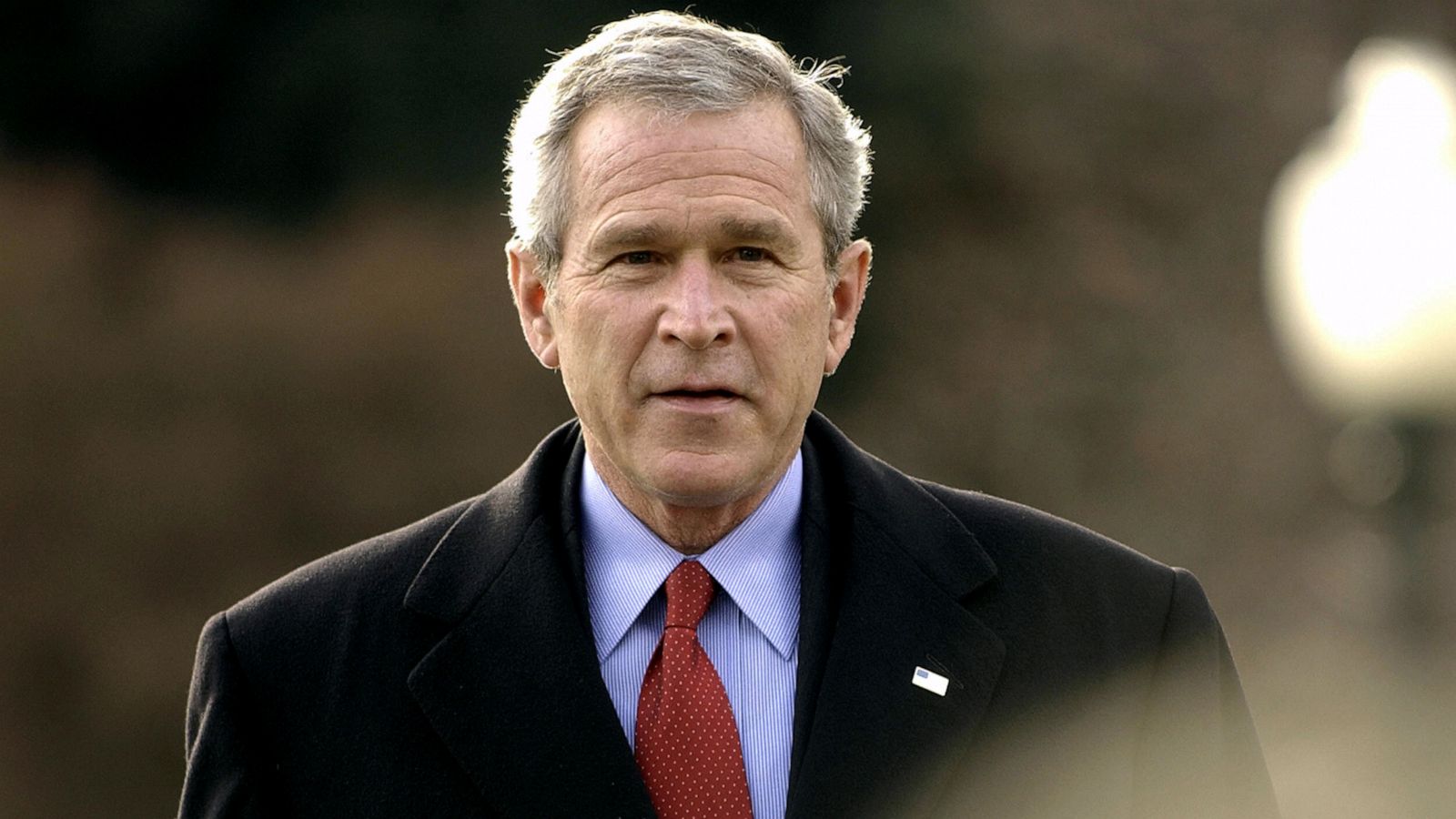
George W. Bush
George Walker Bush is an American politician and businessman who served as the 43rd president of the United States from 2001 to 2009.
Why George W. Bush Appears in the Documents
George W. Bush is mentioned in 77 documents within the Epstein file corpus, consisting of 41 articles, 22 emails, 3 books, 3 legals, 1 collection, 1 document, 1 interview, 1 letter, 1 memo, 1 presentation, 1 regulatory, 1 speech, originating from the House Oversight Committee.
These documents include titles such as "Email chain on Ghislaine Maxwell, 9/11, and deep state conspiracies", "Perversion of Justice: Epstein and Associates", "Fw: The new iterations of Ghislaine Maxwell" among others. George W. Bush's name appears across these documents in various contexts. The document corpus contains a wide range of materials including media coverage, government records, and legal proceedings where many public figures are mentioned.
Disclaimer: Appearing in the Epstein document corpus does not imply wrongdoing, guilt, or any form of association with criminal activity. Many public figures are mentioned incidentally in these documents due to the broad scope of the released materials.
Documents (50)
Email chain on Ghislaine Maxwell, 9/11, and deep state conspiracies
The document is a sprawling, conspiratorial email chain that assembles unverified claims of a continuous “Deep State” operation linking government agencies, defense contractors (SAIC, Leidos, IBM, Tetra Tech), and influential families to surveillance, political manipulation, and sexual exploitation; it weaves together events from the Halloween Massacre era through 9/11 to Benghazi and the death of Justice Scalia, citing sources like Peter Dale Scott to portray covert intelligence ties, global contractor networks, bioterrorism concerns, and international partners as part of a supposed “New World Order.”
Source: House Oversight Committee
Perversion of Justice: Epstein and Associates
The piece portrays Jeffrey Epstein as a man of enormous, opaque wealth and a lavish, globe‑trotting lifestyle—along with properties on the waterfront in Palm Beach, a private island, a Gulfstream jet and even a Boeing 727—that raises persistent questions about how his fortune was made. It recounts lawsuits alleging that Epstein and his associate Ghislaine Maxwell organized underage sexual parties on his private plane, including a 2015 federal case by Virginia Roberts that was settled in 2017, while noting Maxwell’s denials. The article also traces Epstein’s high‑profile connections, from a 2002 flight for Bill Clinton on Epstein’s jet to support AIDS work to a formidable defense team that included Kenneth Starr, Alex Acosta, Jay Lefkowitz and Bruce Reinhart, illustrating how money and influence were used to shape the legal narrative. It underscores the clash between Epstein’s political philanthropy and the criminal scrutiny he faced, including a controversial 2006 non‑prosecution agreement, and references the notoriety of his “Lolita Express” reputation as investigators and victims seek accountability.
Source: House Oversight Committee
Fw: The new iterations of Ghislaine Maxwell
This high-urgency email chain presents a sprawling conspiracy narrative in which the author contends that a Deep State network—binding the CIA, FBI, Secret Service, DHS, and major contractors like SAIC, IBM, Leidos, Accenture, and Tetra Tech—has for decades orchestrated or enabled major political and security events, from the Halloween Massacre and 9/11 to Benghazi and pervasive surveillance, while tying in alleged corruption, child exploitation, and cover-ups involving figures such as Rumsfeld, Cheney, Epstein, Starr, and various corporate players. It weaves together references to The American Deep State, the 9/11 Commission Report, and alleged ties between government and private interests to argue that counterterrorism and bioterrorism are being used to advance a New World Order. The tone is accusatory and personal, linking historical events to alleged abuses, extensive surveillance, and systemic corruption across government and industry.
Source: House Oversight Committee
Jeffrey Epstein's attorneys fight to keep plea discussions private
Jeffrey Epstein's defense team has asked a federal judge to seal correspondence with federal prosecutors about the nonprosecution agreement, arguing that releasing the letters would chill future plea negotiations. The two alleged victims, who say Epstein molested more than 30 girls between 2001 and 2007, contend the deal should be nullified because they were not adequately informed and seek access to the communications in a civil suit, while the government maintains the Crimes Victims Rights Act does not apply since no federal charges were filed.
Source: House Oversight Committee
Re: Subject to change
An internal email about trimming a controversial 700-page collection to 400 pages, in which Paul Krassner shares a revised mini-essay that admits there is no evidence that Donald Trump raped a 13-year-old (though there is an accusation) and adds a more hopeful ending, while referencing a Guardian piece and a PR-driven setup; the message also includes a fiery, op-ed–style tirade about the 2000 and 2016 elections and Trump’s alleged faults, finishing with a confidential, attorney‑client‑style notice and contact details.
Source: House Oversight Committee
Foreign Intelligence Surveillance Act Abuses at the DOJ and FBI
This declassified White House–released memo updates the House Intelligence Committee’s investigation into how the DOJ and FBI used the Foreign Intelligence Surveillance Act during the 2016 election, asserting significant concerns about the legitimacy and legality of FISC interactions and a breakdown of safeguards against abuse. It argues that the Carter Page FISA applications relied on the Steele dossier—funded by the DNC and Clinton campaign—yet omitted or obscured political origins and other critical facts, including Steele’s ties to the media, his termination as a source, and the dossier’s limited corroboration; it also highlights undisclosed connections involving Bruce Ohr and Fusion GPS, and notes biased conduct by FBI officials, suggesting serious misconduct and ongoing risks to civil liberties that warrant continued congressional oversight.
Source: House Oversight Committee
Inside Job (2010) Film Review
Inside Job, Charles Ferguson’s 2010 documentary, traces the 2008 financial crisis to two decades of deregulation, risky derivatives, and the collusion of banks, rating agencies, and policymakers, presenting a sweeping, rigorously argued history from Reagan through Iceland. Through dozens of interviews, archival clips, and Matt Damon’s narration, it argues the disaster was a preventable outcome born of warped values, groupthink, and conflicts of interest across both political parties and the economics profession. Though some key players declined to participate and the film may leave viewers unsettled or angrier, it delivers a clear, well-supported case and a provocative call for meaningful reform.
Source: House Oversight Committee
Alex Acosta Epstein plea deal critique
These messages scrutinize Alex Acosta’s handling of Jeffrey Epstein’s case, arguing that Acosta let Epstein off with a lenient 13‑month sentence and a civil settlement that barred victims from testifying, a move the thread suggests was driven by Acosta’s desire to curry favor with powerful Washington figures like Ken Starr and Jay Lefkowitz to advance his own career. It portrays the deal as a betrayal of Epstein’s victims and notes bipartisan pressure, including conservatives such as Concerned Women for America and Republicans Ben Sasse and Marco Rubio, with Rubio awaiting Acosta’s side; the discussion ends by warning that Trump may decide Acosta’s fate if the controversy undermines the administration.
Source: House Oversight Committee
The Ayatollah Under the Bed(sheets)
Karim Sadjadpour argues that in the Islamic Republic of Iran, sexuality is not a private matter but a central instrument of state power: the regime uses hijab, sexual morality, and even practices like temporary marriages and public shaming as tools to suppress dissent, regulate society, and legitimate its rule, while tolerating or exploiting vice when expedient. The piece traces how moral policing, censorship, and gender policing permeate every arena—from seminaries to the economy—driven by a maslahat logic that seeks control more than moral clarity, even as a young, connected population pushes back and Western cultural influence challenges the regime’s puritanical foundations. In this paradox, Tehran fears cultural decay—more than artillery—as the key threat to the regime, shaping its strategic calculus toward preserving power through morality.
Source: House Oversight Committee
The Ayatollah Under the Bed(sheets)
Karim Sadjadpour argues that in the Islamic Republic of Iran, sexuality is not a private matter but a central instrument of state power: the regime uses hijab, sexual morality, and even practices like temporary marriages and public shaming as tools to suppress dissent, regulate society, and legitimate its rule, while tolerating or exploiting vice when expedient. The piece traces how moral policing, censorship, and gender policing permeate every arena—from seminaries to the economy—driven by a maslahat logic that seeks control more than moral clarity, even as a young, connected population pushes back and Western cultural influence challenges the regime’s puritanical foundations. In this paradox, Tehran fears cultural decay—more than artillery—as the key threat to the regime, shaping its strategic calculus toward preserving power through morality.
Source: House Oversight Committee
Alex Acosta update: Epstein plea deal and political fallout
This memo argues that the Epstein plea deal, brokered by then-U.S. Attorney Alex Acosta, let Epstein avoid a harsh sentence and shield victims by burying testimony in a civil settlement, and that Acosta’s conduct appears driven by a desire to curry favor with powerful figures—Ken Starr and Jay Lefkowitz—and to position himself for future opportunities at Kirkland & Ellis, rather than by prosecutorial zeal. It notes bipartisan and conservative calls for Acosta’s resignation, including from Sen. Ben Sasse and Concerned Women for America, and suggests his defenses are weak and unconvincing, leaving his cabinet future uncertain and contingent on Trump’s political calculus.
Source: House Oversight Committee
Alex Acosta update (Power Line)
The document forwards a Power Line piece arguing that Alex Acosta, then the U.S. Attorney and now the Secretary of Labor, let Jeffrey Epstein off with a lenient plea to avoid a civil suit that could have exposed his victims to testimony, a deal the author contends was arranged to curry favor with powerful Washington figures like Ken Starr and Jay Lefkowitz and to boost Acosta’s own career prospects. It highlights bipartisan and conservative calls for Acosta’s resignation, questions his motivations, and suggests that his willingness to accommodate influential people may jeopardize his ability to stay in the Trump administration.
Source: House Oversight Committee
Alex Acosta update: Epstein plea deal and political fallout
This memo argues that the Epstein plea deal, brokered by then-U.S. Attorney Alex Acosta, let Epstein avoid a harsh sentence and shield victims by burying testimony in a civil settlement, and that Acosta’s conduct appears driven by a desire to curry favor with powerful figures—Ken Starr and Jay Lefkowitz—and to position himself for future opportunities at Kirkland & Ellis, rather than by prosecutorial zeal. It notes bipartisan and conservative calls for Acosta’s resignation, including from Sen. Ben Sasse and Concerned Women for America, and suggests his defenses are weak and unconvincing, leaving his cabinet future uncertain and contingent on Trump’s political calculus.
Source: House Oversight Committee
Is Rod Rosenstein fired, resigning, or staying? The drama, explained.
This piece explains the Monday–week drama over Deputy Attorney General Rod Rosenstein—who appointed Mueller and oversees the Russia investigation—and how competing leaks and reports about whether he would resign, be fired, or stay fueled a high-stakes White House power struggle around the probe, including discussions of replacing Rosenstein or Sessions and the broader politics surrounding the investigation, with Rosenstein still in his post at the time of publication.
Source: House Oversight Committee
Inside Job documentary review and discussion
Inside Job (2010) is a rigorously argued documentary by Charles Ferguson, hailed as a New York Times Critic’s Pick, that traces the 2008 financial crisis from deregulation and risky derivatives to the housing-market collapse and the perceived complicity of Wall Street, policymakers, and economists. Through dozens of interviews, archival clips, and Matt Damon’s narration, it makes a persuasive, morally forceful case that the system encouraged reckless behavior with scant accountability, ending with a blunt call for structural reform, even as some voices were absent and the film could have more fully explored the impact on ordinary people.
Source: House Oversight Committee
Email — Alternative Facts: Satire piece by Paul Krassner
Paul Krassner’s final piece in his 60-year collection of investigative satire, “Alternative Facts,” delivers a blistering, unapologetic critique of the era’s misinformation and political theater, tracing the Electoral College’s role in the 2000 Bush victory, recalling Hillary Clinton’s vow to abolish it, and contrasting that history with the 2016 Trump win despite the national popular vote, while naming Putin, Flynn, Pence, Ryan, and Steve Bannon as figures in a tangled web of power and manipulation; through sharp irony and provocative language it argues that truth, humor, and steadfast resistance can counter authoritarianism even as it skewers the era’s “fake news” and the cruelty that awakened a restless public.
Source: House Oversight Committee
They're Not Really Out to Get You
Edward Jay Epstein’s Wall Street Journal review of Rob Brotherton’s Suspicious Minds argues that conspiracy thinking emerges from ordinary cognitive quirks—such as confirmation bias and biased assimilation—that cause people to seek evidence that confirms preconceptions, allowing pseudo-conspiracies to spread while real conspiracies occur in fields from terrorism to finance; he traces the historical shift in how we use the term “conspiracy theory” after the Warren Commission, contrasts plausible investigations (like the Confederate role in Lincoln’s assassination) with patently unfounded claims (the moon landing was faked, Area 51 aliens, Obama as a Kenyan communist), and through Brotherton’s framework offers a thoughtful guide to evaluating conspiracies, noting there is no simple cure for our brains’ tendency to leap to conspiratorial conclusions.
Source: House Oversight Committee
Review: Inside Job (2010)
This forwarded email contains a New York Times Critics’ Pick review of the 2010 documentary Inside Job, which offers a rigorous, well-argued history of the 2008 financial crisis—from Reagan-era deregulation to the growth of complex derivatives—arguing that warped values, groupthink, and conflicts of interest among policymakers, academics, and bankers caused the meltdown; with extensive interviews and Matt Damon narrating, the film is praised for its clear, measured, morally forceful critique and its call for real reform, even as it can leave viewers dispirited.
Source: House Oversight Committee
Debate on Cultural Evolution, Psychopathy, and Evolutionary Genetics
This is a heated, cross-experimental debate about what really shapes human behavior, cooperation, and conflict, arguing against a purely cultural-evolution narrative and insisting that genetic and biological processes—such as parasite pressures, kin selection, and psychopathic tendencies in leaders—remain central; the author challenges the idea that culture provides a discrete, inheritable unit of variation, criticizes cultural explanations as insufficient for explaining phenomena like language diversity, social norms, and honor killings, and presses for an integrated view that combines genetic, developmental, and cultural factors, illustrated by references to empirical work on youth psychopathy and provocative real-world examples from political and historical leaders.
Source: House Oversight Committee
Trump says he has foreign policy experience because he ran the Miss Universe pageant in Russia
An email summarizing Hillary Clinton’s speech in San Diego in which she labels Donald Trump’s foreign policy as “dangerously incoherent,” contrasts his claim of experience from running Miss Universe in Russia with her own qualifications, and outlines Trump’s hardline proposals—reinstating waterboarding, renegotiating trade deals, a Muslim ban, and pressuring NATO—while also criticizing his stance on Benghazi and the Iraq War.
Source: House Oversight Committee
Scientists create human embryos to make stem cells
Researchers at Oregon Health & Science University have, for the first time, created human embryos that are genetic copies of living people and used them to derive embryonic stem cells, offering a path to patient-specific tissues that could treat diseases like Alzheimer's and diabetes, while reviving ethical concerns about reproductive cloning; by using somatic cell nuclear transfer, they combined a donor's skin cell with an enucleated egg, grew embryos to the stem-cell stage, and produced six embryonic stem cell lines that matched the donor’s genome, signaling potential immune‑compatible transplants but prompting calls for clear federal rules and safeguards.
Source: House Oversight Committee
Alan Dershowitz: Takes The Stand—An Autobiography
Source: House Oversight Committee
White House National Security Adviser Speaks to Hamas-Linked Group
Bill Siegel’s March 2011 analysis critiques Denis McDonough’s claim that the United States is not at war with Islam, arguing that reducing the threat to a small band of “radical extremists” ignores two additional fronts—the Civilization Jihad and the International Institutional Jihad—within what he calls the “Control Factor.” The piece contends this framing fosters a root-cause narrative that avoids hard confrontation, transfers responsibility to the West, and perpetuates a dangerous sense of control and guilt, undermining the ability to counter all three levels of threat; it warns that such thinking could lead to national self-destruction and calls for a clear recognition and confrontation of the broader jihadist challenge.
Source: House Oversight Committee
EB Draft Ch1-25
Source: House Oversight Committee
EB Draft Ch1-25
Source: House Oversight Committee
EB Draft Ch1-25
Source: House Oversight Committee
Geopolitical Articles Digest – August 2011
This six-article bundle from August 2011 surveys how leadership psychology, international intervention, and long-running regional conflicts shape the Middle East and U.S. policy: Scientific American analyzes Muammar Qadhafi’s possible detachment from reality and narcissism; The Financial Times argues that Libya intervention proved the sceptics wrong and offers hard-won lessons; Foreign Policy reports on Sinai’s Bedouin-led unrest and its impact on post-Mubarak Egypt; The National Interest critiques Obama’s foreign policy and lays out looming strategic choices involving Pakistan, China, and Russia; The New York Times reviews Dick Cheney’s memoir and his take on Syria and other thorny issues; and Ma’an News Agency provides a historical overview of Palestine and the statehood question, including UN pathways and international law.
Source: House Oversight Committee
EB Draft Ch1-25
Source: House Oversight Committee
EB Draft Ch1-25
Source: House Oversight Committee
EB Draft Ch1-25
Source: House Oversight Committee
Compendium of six 2011 articles: Gaza flotilla, Strauss-Kahn affair, Palestine paradigm, the West vs the Rest, South China Sea, and brain science
Six contemporary essays—Bronner’s Gaza flotilla analysis and the politics of public narrative, Lévy’s critique of the Strauss-Kahn affair and the perils of justice becoming a spectacle, Musa and Sarrif’s bold one-state paradigm for Palestine, Hadar’s defense of Western leadership in a multipolar world, Valencia’s exploration of South China Sea tensions and U.S. role, and Linden’s accessible science on how the brain regulates appetite via leptin and the hypothalamus—offer a compact, provocative survey of how narratives, power, international law, and biology shape politics, justice, and human behavior.
Source: House Oversight Committee
Evilicious
Marc D. Hauser’s Evilicious provides a science-grounded account of why humans commit extraordinary harms: evil is not a rare defect but an incidental byproduct of a promiscuously connected brain that can fuse desire with denial, reward with punishment, and in-group loyalty with out-group hostility. Drawing on evolution, genetics, neuroscience, and social science, Hauser traces how hormones like testosterone, neurotransmitters such as dopamine and serotonin, and genes like MAOA, DRD4, and COMT shape risk, self-control, and the taste for harm, while social dynamics—dehumanization, moral disengagement, bystander effects, and large-scale cooperation—show how everyday aggression can escalate into violence, genocide, or corruption. He argues that our capacity for both great kindness and great cruelty arises from the same core architecture, and that understanding these core ingredients can illuminate moral responsibility, inform policy and law, and equip us to foster a more humane future. A compact, provocative synthesis, the book reveals evil as a predictable, learnable aspect of human nature—and urges us to confront it with science, education, and compassion.
Source: House Oversight Committee
Compendium of six 2011 articles: Gaza flotilla, Strauss-Kahn affair, Palestine paradigm, the West vs the Rest, South China Sea, and brain science
Six contemporary essays—Bronner’s Gaza flotilla analysis and the politics of public narrative, Lévy’s critique of the Strauss-Kahn affair and the perils of justice becoming a spectacle, Musa and Sarrif’s bold one-state paradigm for Palestine, Hadar’s defense of Western leadership in a multipolar world, Valencia’s exploration of South China Sea tensions and U.S. role, and Linden’s accessible science on how the brain regulates appetite via leptin and the hypothalamus—offer a compact, provocative survey of how narratives, power, international law, and biology shape politics, justice, and human behavior.
Source: House Oversight Committee
April 2011 Middle East Policy Commentary
The four excerpts, drawn from The Cairo Review of Global Affairs, Foreign Policy, The Washington Post, and The National Interest in April 2011, converge on a critical rethinking of U.S. policy in the Middle East and beyond in a moment of regional upheaval. William B. Quandt argues for a bold, internationally backed peace initiative that brackets the Israeli–Palestinian and Israeli–Syrian tracks, warning that delaying progress would marginalize the United States as the region shifts toward democracy. Colum Lynch details how U.S. diplomacy at the U.N. sought to blunt a Goldstone-style war-crimes investigation of Israel’s Gaza operation, highlighting deliberate American influence behind the scenes at the United Nations. David Ignatius calls for a strategic pivot in national security spending—prioritizing Egypt’s democratic transition and rebalancing Af–Pak policy toward diplomacy and reconstruction rather than full-scale military means. Jacob Heilbrunn, meanwhile, critiques the liberal-interventionist impulse embodied by Samantha Power, arguing that humanitarian interventions—like Libya—risk hubris and unintended consequences, and urging a more cautious appraisal of when, where, and how force should be used in pursuit of democracy and human rights.
Source: House Oversight Committee
Fire and Fury
Source: House Oversight Committee
April 2011 Middle East Policy Commentary
The four excerpts, drawn from The Cairo Review of Global Affairs, Foreign Policy, The Washington Post, and The National Interest in April 2011, converge on a critical rethinking of U.S. policy in the Middle East and beyond in a moment of regional upheaval. William B. Quandt argues for a bold, internationally backed peace initiative that brackets the Israeli–Palestinian and Israeli–Syrian tracks, warning that delaying progress would marginalize the United States as the region shifts toward democracy. Colum Lynch details how U.S. diplomacy at the U.N. sought to blunt a Goldstone-style war-crimes investigation of Israel’s Gaza operation, highlighting deliberate American influence behind the scenes at the United Nations. David Ignatius calls for a strategic pivot in national security spending—prioritizing Egypt’s democratic transition and rebalancing Af–Pak policy toward diplomacy and reconstruction rather than full-scale military means. Jacob Heilbrunn, meanwhile, critiques the liberal-interventionist impulse embodied by Samantha Power, arguing that humanitarian interventions—like Libya—risk hubris and unintended consequences, and urging a more cautious appraisal of when, where, and how force should be used in pursuit of democracy and human rights.
Source: House Oversight Committee
Fire and Fury
Source: House Oversight Committee
The Greatest Dirty Joke Ever Told
Frank Rich argues that the trauma of 9/11 intensified a cultural fight over freedom of expression in America, celebrating Gilbert Gottfried’s infamous Aristocrats routine at the Friars Club roast as a moment of shock therapy that helped a grieving city begin to live again. He uses the documentary The Aristocrats to show how comedians across generations push boundaries, even as their material unsettles power and propriety. Rich then critiques a rising decency police—embodied by Ted Stevens’s threats to regulate language, the censorship surrounding Deadwood, and bipartisan political correctness—that seeks to rewrite American history and culture to fit narrow agendas. He argues that vulgarity and frontier frankness are part of the nation’s birthright, and that suppressing them threatens the very essence of American freedom.
Source: House Oversight Committee
Collection of opinion articles on Netanyahu and the Israeli-Palestinian conflict (2011)
These seven opinion pieces from May 2011 present a wide-ranging debate over Israel, Palestine, and the path to peace: Fareed Zakaria argues that Netanyahu’s insistence on shifting away from land-for-peace weakens Israel and undercuts its future, while NYT reporters describe how Obama’s Israel policy has become a wedge issue in the 2012 race; Daniel Byman cautions against conflating Hamas with al Qaeda and urges engaging with a pragmatic Hamas as part of a peace process; Jeffrey Goldberg contends that Palestinians may have time on their side and that Israel needs a bold peace vision; Peter Beinart highlights a rising Palestinian nonviolent movement seeking rights and statehood, even if two-state realism wanes; Asharq Al-Awsat reports internal Hamas tensions but insists on unity in practice; and Edward Glick reflects on the enduring reality of war and deterrence in a nuclear-tinged world.
Source: House Oversight Committee
The Greatest Dirty Joke Ever Told
Frank Rich argues that the trauma of 9/11 intensified a cultural fight over freedom of expression in America, celebrating Gilbert Gottfried’s infamous Aristocrats routine at the Friars Club roast as a moment of shock therapy that helped a grieving city begin to live again. He uses the documentary The Aristocrats to show how comedians across generations push boundaries, even as their material unsettles power and propriety. Rich then critiques a rising decency police—embodied by Ted Stevens’s threats to regulate language, the censorship surrounding Deadwood, and bipartisan political correctness—that seeks to rewrite American history and culture to fit narrow agendas. He argues that vulgarity and frontier frankness are part of the nation’s birthright, and that suppressing them threatens the very essence of American freedom.
Source: House Oversight Committee
Clinton attacks Trump's foreign policy as 'dangerously incoherent'
In the 2016 campaign, Hillary Clinton derides Donald Trump’s foreign policy as dangerously incoherent in a San Diego speech, while Trump defends his so-called experience—mocked by Clinton as running the Miss Universe pageant in Russia—as he advocates hardline moves on NATO, waterboarding, and a Muslim entry ban, highlighting a fierce policy clash over issues from Benghazi and the Iraq War to North Korea and broader national security.
Source: House Oversight Committee
Overview of U.S. AML Laws and Regulatory Framework
This document offers a practical, comprehensive overview of money laundering and terrorist financing, clarifying how their drivers and patterns differ, and then detailing the U.S. regulatory framework (the Bank Secrecy Act, the USA PATRIOT Act, and related statutes) and the roles of key regulators, enforcement tools, and international benchmarks. It additionally guides readers on measuring AML regime effectiveness, common program deficiencies, the enforcement landscape with real-world case examples, and how technology supports AML controls, client due diligence, reporting, and training.
Source: House Oversight Committee
The Search for Peace in the Arab–Israeli Conflict: A Compendium of Documents and Analysis
Oxford University Press's The Search for Peace in the Arab–Israeli Conflict is a sourcebook of documents and analysis that charts the long, often jagged pursuit of peace from the Sykes–Picot era to the 2014 Gaza crisis. Edited by Terje Rød-Larsen, Nur Laiq, and Fabrice Aidan, it assembles key peace agreements, proposals, UN and regional records, and domestic texts across five thematic parts, enhanced by maps and a guiding chronology. Its centerpiece, The Crooked Course, explains how gradualist and totalist approaches shaped negotiations—from Oslo and Madrid to the Road Map and the Quartet—highlighting both breakthroughs and dead ends, and offering a rigorous reference for scholars, policymakers, and students seeking to understand what works, what fails, and why.
Source: House Oversight Committee
The Search for Peace in the Arab–Israeli Conflict: A Compendium of Documents and Analysis
Oxford University Press's The Search for Peace in the Arab–Israeli Conflict is a sourcebook of documents and analysis that charts the long, often jagged pursuit of peace from the Sykes–Picot era to the 2014 Gaza crisis. Edited by Terje Rød-Larsen, Nur Laiq, and Fabrice Aidan, it assembles key peace agreements, proposals, UN and regional records, and domestic texts across five thematic parts, enhanced by maps and a guiding chronology. Its centerpiece, The Crooked Course, explains how gradualist and totalist approaches shaped negotiations—from Oslo and Madrid to the Road Map and the Quartet—highlighting both breakthroughs and dead ends, and offering a rigorous reference for scholars, policymakers, and students seeking to understand what works, what fails, and why.
Source: House Oversight Committee
Arab Spring and Middle East Analysis (2011 compilation of six articles)
Taken together, these six mid-2011 articles survey a world undergoing rapid transformation: the Arab Spring has unsettled regimes from Tunisia to Bahrain and forced a reassessment of Western credibility and engagement in the region; Israel and the Palestinian question remain a volatile hinge in regional politics, while Islamist movements like Ennahda and the Muslim Brotherhood face new multi‑party realities; Al Qaeda’s leadership succession under Zawahiri signals a renewed but precarious Islamist threat; the United States wrestles with how much foreign policy still matters to an economy-focused electorate; Europe confronts a faltering eurozone, rising social unrest, and the limits of its leadership in a shifting global order; and a lengthy analysis of potential conflict with Iran underscores the extensive military, diplomatic, economic and social spillovers of a war, the uncertainties of escalation, and the daunting task of planning for a protracted, multi-domain confrontation.
Source: House Oversight Committee
Revealed: the world's most admired people
The Times-YouGov global survey reveals Bill Gates as the world’s most admired person, with Pope Francis, Barack Obama, Billy Graham and George W. Bush ahead of him in the U.S. and Gates topping the list in China; the Queen is the most admired woman overall, trailed by Jolie and Oprah, and the results show strong political, business and sports figures across nations while highlighting gender imbalances in some countries. The study also maps national leaders (Putin in Russia, Merkel in Germany, Sarkozy in France, Goodluck Jonathan in Nigeria) and notes that few local politicians reach the top ten in Australia and the UK, illustrates the media’s influence on who people admire (Pope Francis rising after Time’s Person of the Year) and even mentions Mandela’s near-top status had he been considered earlier; a concise Who’s Who section lists figures like Modi, Bachchan, Abdul Kalam, Anna Hazare, Arvind Kejriwal, Peng Liyuan, Abdul Sattar Edhi and Jokowi Widodo. Based on surveys of 13,895 people in 13 countries, the document also asks who is the most famous person in the world, with Obama leading that question.
Source: House Oversight Committee
Middle East Policy Commentary Roundup, April 2011
This collection gathers six 2011 analyses that together map how the Arab Spring, the Israeli-Palestinian impasse, and shifting Gulf power converge to reorder regional politics and Western strategy: a looming Palestinian statehood bid and Israel’s settlement debates; the deeper economic and political rot beneath Arab regimes and the need to rebuild constitutional states; a critical take on Barack Obama’s Libya intervention and the limits of American leadership without a clear doctrine; the fragile, divided trajectory of Egypt’s stalled revolution and the danger of an illiberal bias in the transition; and Qatar’s ascent as a quiet yet influential U.S. ally whose media reach, diplomacy, and energy wealth complicate regional dynamics and alliance calculations.
Source: House Oversight Committee
June 2011 – Selected International Affairs Articles
These seven articles offer a timely mosaic of a world navigating the fallout of the Arab Spring, the Gaza blockade, and shifting global power, market, and governance dynamics. They reveal Gaza’s fragile, uneven signs of growth—new hotels, cars, and tunnels—alongside persistent poverty and crumbling public services, highlighting how economic activity can mask deeper humanitarian needs. They argue for a pragmatic path to Palestinian statehood via UN recognition, while cautioning that the fate of borders, security arrangements, and regional normalization will shape any peace ahead. Across the Middle East and Asia, they weigh whether benevolent autocracy and strategic diplomacy can deliver stability and growth as effectively as Western-style democracy, all against the backdrop of oil-market volatility, U.S. defense realignments, and the evolving security threats from Iran and beyond. In sum, the collection posits that credible institutions, secure borders, and realistic reforms—rather than rhetoric alone—will determine the region’s and the world’s near‑term trajectory.
Source: House Oversight Committee
Op-Ed: Israel's security, the two-state solution, and regional peace opportunities
An op-ed attributed to Israel’s former defense minister Ehud Barak argues that in a geopolitically destabilized Middle East Israel must remain soberly confident and tightly allied with the United States while seizing a historic opportunity to reshape regional peace with Arab moderates. It maintains that a viable two-state solution—Palestinian demilitarization, secure borders, major settlement blocs with swaps, and an Israeli military presence along the Jordan River—remains defendable with strong security margins and a robust US partnership, and it warns that a one-state outcome would be dangerous for Israel’s identity and democracy. The piece calls for bold, Tenacious leadership to deter, counter threats from Iran, Syria, Hezbollah, and Hamas, and advocates proactive diplomacy, including considering a revised Saudi/Arab League plan as a negotiation framework, while acknowledging that Israel must be prepared to act unilaterally if necessary.
Source: House Oversight Committee
Op-Ed: Israel's security, the two-state solution, and regional peace opportunities
An op-ed attributed to Israel’s former defense minister Ehud Barak argues that in a geopolitically destabilized Middle East Israel must remain soberly confident and tightly allied with the United States while seizing a historic opportunity to reshape regional peace with Arab moderates. It maintains that a viable two-state solution—Palestinian demilitarization, secure borders, major settlement blocs with swaps, and an Israeli military presence along the Jordan River—remains defendable with strong security margins and a robust US partnership, and it warns that a one-state outcome would be dangerous for Israel’s identity and democracy. The piece calls for bold, Tenacious leadership to deter, counter threats from Iran, Syria, Hezbollah, and Hamas, and advocates proactive diplomacy, including considering a revised Saudi/Arab League plan as a negotiation framework, while acknowledging that Israel must be prepared to act unilaterally if necessary.
Source: House Oversight Committee