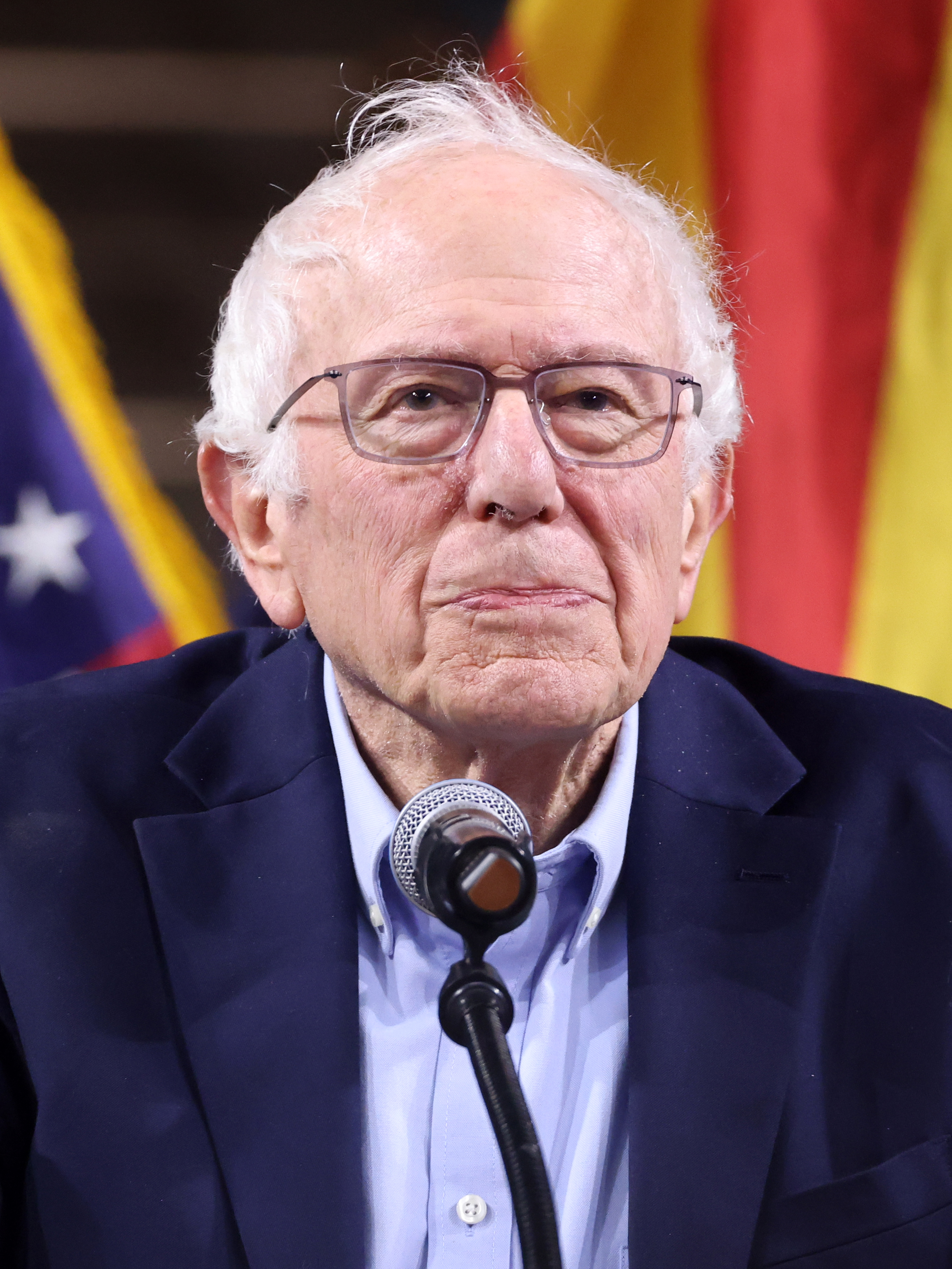
Bernie Sanders
Bernard Sanders is an American politician and activist who has served as the junior United States senator from Vermont since 2007. He has been the longest-serving independent in U.S. congressional history.
Why Bernie Sanders Appears in the Documents
Bernie Sanders is mentioned in 40 documents within the Epstein file corpus, consisting of 22 emails, 11 articles, 2 interviews, 1 briefing, 1 chat, 1 legal, 1 reference, 1 report, originating from the House Oversight Committee.
These documents include titles such as "Polities and law: Analysis of Russian interference in the 2016 U.S. elections", "Bystander_#4 JAN 17.indd", "Trump says he has foreign policy experience because he ran the Miss Universe pageant in Russia" among others. Bernie Sanders's name appears across these documents in various contexts. The document corpus contains a wide range of materials including media coverage, government records, and legal proceedings where many public figures are mentioned.
Disclaimer: Appearing in the Epstein document corpus does not imply wrongdoing, guilt, or any form of association with criminal activity. Many public figures are mentioned incidentally in these documents due to the broad scope of the released materials.
Documents (40)
Polities and law: Analysis of Russian interference in the 2016 U.S. elections
Edward Jay Epstein argues that the 2016 presidential race was shaped by three disclosure operations likely orchestrated by Russian intelligence and leaked through intermediaries: the Trump dossier produced by Fusion GPS and Orbis (Steele) to major outlets; the release of DNC emails attributed to the Kremlin via DC Leaks; and a Veselnitskaya meeting in which Russia allegedly offered dirt on Hillary Clinton. He suggests the material may have been curated with FSB involvement and highlights how monitored channels, including Kislyak’s open line, exposed Trump associates and fueled distrust in U.S. institutions. While the intelligence community framed Putin’s aim as hurting Clinton and helping Trump, Epstein argues the Kremlin’s broader objective was to undermine confidence in American democracy and U.S. standing, using disclosures as a strategic tool.
Source: House Oversight Committee
Polities and law: Analysis of Russian interference in the 2016 U.S. elections
Edward Jay Epstein argues that the 2016 presidential race was shaped by three disclosure operations likely orchestrated by Russian intelligence and leaked through intermediaries: the Trump dossier produced by Fusion GPS and Orbis (Steele) to major outlets; the release of DNC emails attributed to the Kremlin via DC Leaks; and a Veselnitskaya meeting in which Russia allegedly offered dirt on Hillary Clinton. He suggests the material may have been curated with FSB involvement and highlights how monitored channels, including Kislyak’s open line, exposed Trump associates and fueled distrust in U.S. institutions. While the intelligence community framed Putin’s aim as hurting Clinton and helping Trump, Epstein argues the Kremlin’s broader objective was to undermine confidence in American democracy and U.S. standing, using disclosures as a strategic tool.
Source: House Oversight Committee
Bystander_#4 JAN 17.indd
An intimate, wide‑ranging interview with Paul Krassner, founder of The Realist, tracing how his fearless blend of satire and investigative reporting—shaped by Lenny Bruce, Abbie Hoffman, and a steadfast ethics—helped redefine American political discourse from the magazine’s early days to the Trump era, including controversial abortion-referral work and iconic pieces like the Disneyland Memorial Orgy and the LBJ takedown, while highlighting The Realist Archive Project and The Realist Cartoons as enduring showcases of how free expression can illuminate power, hypocrisy, and the urgent need for change.
Source: House Oversight Committee
Trump says he has foreign policy experience because he ran the Miss Universe pageant in Russia
An email summarizing Hillary Clinton’s speech in San Diego in which she labels Donald Trump’s foreign policy as “dangerously incoherent,” contrasts his claim of experience from running Miss Universe in Russia with her own qualifications, and outlines Trump’s hardline proposals—reinstating waterboarding, renegotiating trade deals, a Muslim ban, and pressuring NATO—while also criticizing his stance on Benghazi and the Iraq War.
Source: House Oversight Committee
Trump says he has foreign policy experience because he ran the Miss Universe pageant in Russia
An email summarizing Hillary Clinton’s speech in San Diego in which she labels Donald Trump’s foreign policy as “dangerously incoherent,” contrasts his claim of experience from running Miss Universe in Russia with her own qualifications, and outlines Trump’s hardline proposals—reinstating waterboarding, renegotiating trade deals, a Muslim ban, and pressuring NATO—while also criticizing his stance on Benghazi and the Iraq War.
Source: House Oversight Committee
Game On (Updated 7/6/2016)
LAFFER Associates contends that Donald Trump will win the 2016 presidential election in a Reagan-like landslide, arguing that a stubbornly weak Obama-era economy—evidenced by detrended GDP per adult, the depressed employment-to-population ratio, and sluggish new-home sales—combined with Gallup sentiment data, surging Republican primary turnout, and a dramatic realignment of state legislatures and Congress, signals a demand for pro-growth, supply-side change; with Hillary Clinton tied to the Obama record and a history of perceived missteps, the paper portrays Trump as the stronger candidate to capitalize on the electorate’s econonomic discontent.
Source: House Oversight Committee
Game On (Updated 7/6/2016)
LAFFER Associates contends that Donald Trump will win the 2016 presidential election in a Reagan-like landslide, arguing that a stubbornly weak Obama-era economy—evidenced by detrended GDP per adult, the depressed employment-to-population ratio, and sluggish new-home sales—combined with Gallup sentiment data, surging Republican primary turnout, and a dramatic realignment of state legislatures and Congress, signals a demand for pro-growth, supply-side change; with Hillary Clinton tied to the Obama record and a history of perceived missteps, the paper portrays Trump as the stronger candidate to capitalize on the electorate’s econonomic discontent.
Source: House Oversight Committee
Game On (Updated 7/6/2016)
LAFFER Associates contends that Donald Trump will win the 2016 presidential election in a Reagan-like landslide, arguing that a stubbornly weak Obama-era economy—evidenced by detrended GDP per adult, the depressed employment-to-population ratio, and sluggish new-home sales—combined with Gallup sentiment data, surging Republican primary turnout, and a dramatic realignment of state legislatures and Congress, signals a demand for pro-growth, supply-side change; with Hillary Clinton tied to the Obama record and a history of perceived missteps, the paper portrays Trump as the stronger candidate to capitalize on the electorate’s econonomic discontent.
Source: House Oversight Committee
Re: Gingrich view of Trump
This 2016 email thread among the Kafkases openly endorses Donald Trump, disparages Hillary Clinton and the political establishment, cites Newt Gingrich’s view of Trump’s rise, praises Trump’s deal‑making and “fix it” appeal, and advocates aggressive immigration and security measures as a populist, anti‑establishment response to a seemingly broken political system.
Source: House Oversight Committee
Gingrich view of Trump - email thread
This 2016 email thread between Terry and Philip Kafka argues that Donald Trump is the only candidate capable of fixing a broken nation, contrasting him with Hillary Clinton and Bernie Sanders and railing against establishment politics. It includes a forwarded Newt Gingrich analysis praising Trump as a quick, practical problem-solver, plus a series of persuasive anecdotes and hardline positions on immigration and national security aimed at swaying readers toward Trump over Clinton or Sanders.
Source: House Oversight Committee
Fire and Fury
Source: House Oversight Committee
Fire and Fury
Source: House Oversight Committee
Top Five Questions for the Social Sciences
This email thread captures Moshe Hoffman’s five core questions driving social science—where our moral and political beliefs originate, what shapes our tastes and cultural preferences, how political and economic institutions arise and why they take their current forms, whether there is a fundamental, Darwin-like theory of human societies, and how to fix academia’s perverse incentives—along with Jeffrey E.’s nudge toward evaluating ideas by distribution rather than binary judgments and a provocative call to reform scholarly incentives through cross‑disciplinary collaboration and open, evidence‑based assessment, potentially via Wikipedia‑ or Reddit‑style validation and formal certification of statistical rigor.
Source: House Oversight Committee
Gingrich view of Trump
An internal March 2016 email thread among the Kafka family at Impact Outdoor Advertising debating the 2016 race, in which they endorse Donald Trump, echo Newt Gingrich’s analysis of Trump as a phenomenon and decisive problem-solver, reference Trump’s The Art of the Deal and the Wollman Rink anecdote to illustrate his approach, and couple this with sharp anti-Hillary sentiment and hard-line positions on immigration and the border, all conveyed in a candid, persuasion-minded business correspondence punctuated by personal anecdotes and jokes.
Source: House Oversight Committee
New Tariffs — Trade War
Robert Lawrence Kuhn argues that in the US–China tariff confrontation, China’s public, strong stance is about protecting its legitimacy—economic gains and national pride—while quietly both sides seek a pragmatic solution; the five core US concerns—closed markets, intellectual property protection, industrial espionage, forced technology transfer in joint ventures, and government backing of nascent industries—define the obstacles, and a viable deal may hinge on trading greater market access for credible reforms in IP, tech transfer, and China’s industrial policy, a long-term process unlikely to be resolved before the midterms.
Source: House Oversight Committee
Gingrich view of Trump
An internal March 2016 email thread among the Kafka family at Impact Outdoor Advertising debating the 2016 race, in which they endorse Donald Trump, echo Newt Gingrich’s analysis of Trump as a phenomenon and decisive problem-solver, reference Trump’s The Art of the Deal and the Wollman Rink anecdote to illustrate his approach, and couple this with sharp anti-Hillary sentiment and hard-line positions on immigration and the border, all conveyed in a candid, persuasion-minded business correspondence punctuated by personal anecdotes and jokes.
Source: House Oversight Committee
Clinton attacks Trump's foreign policy as 'dangerously incoherent'
In the 2016 campaign, Hillary Clinton derides Donald Trump’s foreign policy as dangerously incoherent in a San Diego speech, while Trump defends his so-called experience—mocked by Clinton as running the Miss Universe pageant in Russia—as he advocates hardline moves on NATO, waterboarding, and a Muslim entry ban, highlighting a fierce policy clash over issues from Benghazi and the Iraq War to North Korea and broader national security.
Source: House Oversight Committee
iMessage Archive: Conversation between Jee and Larry Summers
This is an iMessage chat transcript from June–July 2019 labeled “HOUSE OVERSIGHT,” detailing a long, multi-threaded exchange between jee and Larry Summers that blends personal banter and professional planning with a deep dive into probability theory. The participants oscillate between technical debates on subjective versus objective probability, Bayesian reasoning, and the applicability of probability to single events, and broader discussions on economics, debt policy, and geopolitical topics—while also sharing personal updates, rehab-related notes, and references to news links and literary topics. The tone is candid and occasionally abrasive, yet the thread paints a picture of two interlocutors weighing risk, outcomes, and strategic decisions across both intellectual and real-world concerns.
Source: House Oversight Committee
Deutsche Bank screenshow template
Deutsche Bank's Global Public Affairs briefing provides a forward-looking risk map for 2015–2016, arguing that geopolitics and energy dynamics will increasingly drive markets, with Middle East instability, a rising NAFTA energy bloc, and China’s ongoing transformation creating long‑term uncertainty; it highlights near-term catalysts such as the Iran nuclear deal, the Trans-Pacific Partnership, and the lifting of oil and gas export bans, while outlining U.S. domestic policy risks in 2015–16 (tax reform, regulatory relief for banks, and housing‑finance reform) alongside a broad sweep of global flashpoints—from Yemen, Libya, and Venezuela to Russia–China energy ties and Cuba—emphasizing how these developments, intertwined with the 2016 U.S. election cycle, could shape investment and strategic risk for financial and corporate clients.
Source: House Oversight Committee
New Tariffs — Trade War
Robert Lawrence Kuhn explains that China views the tariff clash as a calibrated move intended to avoid appearing weak while protecting the gains of its economic rise and national pride, and that Beijing’s retaliations are proportionate and quieter in rhetoric as talks continue; he outlines five unresolved U.S. demands beyond the trade deficit—open markets, stronger intellectual property protection, reduced cyber theft, ending forced technology transfer in joint ventures, and curbs on government subsidies for nascent technologies—which China has begun to address on IP and cyber theft but will not concede on subsidies; with top-level negotiations unlikely before the U.S. midterms, backchannel discussions may be necessary, and while Trump’s tactics are debated, Kuhn suggests that a genuine, targeted agreement aligning U.S. and Chinese interests could emerge if Washington focuses on these core issues and China’s areas of potential concession, yielding a win that benefits both sides through more open markets and restrained state subsidies.
Source: House Oversight Committee
Deutsche Bank screenshow template
Deutsche Bank's Global Public Affairs briefing provides a forward-looking risk map for 2015–2016, arguing that geopolitics and energy dynamics will increasingly drive markets, with Middle East instability, a rising NAFTA energy bloc, and China’s ongoing transformation creating long‑term uncertainty; it highlights near-term catalysts such as the Iran nuclear deal, the Trans-Pacific Partnership, and the lifting of oil and gas export bans, while outlining U.S. domestic policy risks in 2015–16 (tax reform, regulatory relief for banks, and housing‑finance reform) alongside a broad sweep of global flashpoints—from Yemen, Libya, and Venezuela to Russia–China energy ties and Cuba—emphasizing how these developments, intertwined with the 2016 U.S. election cycle, could shape investment and strategic risk for financial and corporate clients.
Source: House Oversight Committee
Smart analysis on big tech – Apple section highlighted
The document cautions that after years of tech leadership, FAANG and other giants face a coming shift as US and EU regulatory scrutiny intensifies, earnings risks mount (notably for Facebook and Apple amid China trade tensions), and public backlash grows, eroding the aura of invincibility around big tech; it points to China’s BAT collapse as a warning sign and warns that investors may soon start pricing in regulatory risk, potentially unraveling passive and algorithmic tech-heavy strategies even as tech remains a market leadership force.
Source: House Oversight Committee
Steve Bannon's clever idea to save the GOP from brutal midterms
Fareed Zakaria reports on Steve Bannon’s argument that the GOP should nationalize the 2018 midterms by making immigration and the border wall the defining issues, appealing to working-class voters—including some Sanders supporters—by framing the race as a clash between nationalists and globalists; while the strategy is politically clever and aligned with Trump’s instincts, Zakaria cautions that limiting H-1B visas could push talent overseas and that deeper education failures—not visa counts—help explain minority underrepresentation, even as the battle over immigration and border security threatens a government showdown if funding for the wall isn’t secured.
Source: House Oversight Committee
Steve Bannon's clever idea to save the GOP from brutal midterms
Fareed Zakaria reports on Steve Bannon’s argument that the GOP should nationalize the 2018 midterms by making immigration and the border wall the defining issues, appealing to working-class voters—including some Sanders supporters—by framing the race as a clash between nationalists and globalists; while the strategy is politically clever and aligned with Trump’s instincts, Zakaria cautions that limiting H-1B visas could push talent overseas and that deeper education failures—not visa counts—help explain minority underrepresentation, even as the battle over immigration and border security threatens a government showdown if funding for the wall isn’t secured.
Source: House Oversight Committee
Smart analysis on big tech – Apple section highlighted
The document cautions that after years of tech leadership, FAANG and other giants face a coming shift as US and EU regulatory scrutiny intensifies, earnings risks mount (notably for Facebook and Apple amid China trade tensions), and public backlash grows, eroding the aura of invincibility around big tech; it points to China’s BAT collapse as a warning sign and warns that investors may soon start pricing in regulatory risk, potentially unraveling passive and algorithmic tech-heavy strategies even as tech remains a market leadership force.
Source: House Oversight Committee
Smart analysis on big tech -- Apple section highlighted
This memo argues that U.S. big-tech leadership (FAANG) may be at risk as regulatory scrutiny in the U.S. and EU intensifies and as China’s BAT stocks slip, suggesting investors should reprice tech risk rather than assume invincibility. It catalogs a wave of regulatory actions—from antitrust hearings and Lina Khan’s appointment to proposed taxes and EU copyright reforms—coupled with rising public concern about surveillance and inequality, which could curb exuberant bets on tech giants. It also flags near-term threats to Apple from the U.S.–China trade war and a softer Chinese handset market, and notes Facebook’s user losses as a sign of fading fundamentals behind the tech rally, collectively signaling a potential turning point where policy and geopolitics begin to erode the Bedrock assumption of evergreen tech profits.
Source: House Oversight Committee
Top Five Questions for the Social Sciences
Moshe Hoffman outlines five central questions for the social sciences: what shapes our moral and political beliefs and why they evolve; what drives our tastes in art and culture; how political and economic institutions arise and why they take their particular forms; whether there is a unifying, evidence-based theory of human societies akin to Darwin’s theory in biology; and how to fix academia’s perverse incentives to reward truth and cross-disciplinary integration rather than prestige, including proposals for more open, collaborative, and certification-based evaluation.
Source: House Oversight Committee
A tax loophole for just Jeffrey Epstein? (Email chain)
This document is a fragmentary email chain between Jeffrey E. and Larry Summers and others discussing a controversial piece titled “A tax loophole for just Jeffrey Epstein?” while also debating presidential power and DOJ independence, quoting Comey on the dangers of politicizing the Justice Department, noting Trump’s potential actions (firing Comey, pardoning Flynn) versus Nixon’s crimes, interspersed with casual remarks, a forwarded video link, and confidentiality notices tied to a House Oversight file.
Source: House Oversight Committee
Smart analysis on big tech -- Apple section highlighted
This memo argues that U.S. big-tech leadership (FAANG) may be at risk as regulatory scrutiny in the U.S. and EU intensifies and as China’s BAT stocks slip, suggesting investors should reprice tech risk rather than assume invincibility. It catalogs a wave of regulatory actions—from antitrust hearings and Lina Khan’s appointment to proposed taxes and EU copyright reforms—coupled with rising public concern about surveillance and inequality, which could curb exuberant bets on tech giants. It also flags near-term threats to Apple from the U.S.–China trade war and a softer Chinese handset market, and notes Facebook’s user losses as a sign of fading fundamentals behind the tech rally, collectively signaling a potential turning point where policy and geopolitics begin to erode the Bedrock assumption of evergreen tech profits.
Source: House Oversight Committee
Steve Bannon's clever idea to save the GOP from brutal midterms
Fareed Zakaria summarizes Steve Bannon’s argument that the GOP should nationalize the 2018 midterms around immigration and border security, using the issue to rally working-class voters—including a significant share of Sanders supporters—and even threaten a government shutdown to secure funding for a border wall. He notes that while the strategy is electorally clever and has broad mainstream appeal, it risks oversimplifying the factors behind educational and economic inequality and could push skilled immigrants to other countries if visas are restricted. Zakaria contrasts Bannon’s analytic approach with Trump’s instinctive positioning, framing the coming elections as part of a longer-running nationalist versus globalist struggle in American politics.
Source: House Oversight Committee
Steve Bannon's clever idea to save the GOP from brutal midterms
Fareed Zakaria summarizes Steve Bannon’s argument that the GOP should nationalize the 2018 midterms around immigration and border security, using the issue to rally working-class voters—including a significant share of Sanders supporters—and even threaten a government shutdown to secure funding for a border wall. He notes that while the strategy is electorally clever and has broad mainstream appeal, it risks oversimplifying the factors behind educational and economic inequality and could push skilled immigrants to other countries if visas are restricted. Zakaria contrasts Bannon’s analytic approach with Trump’s instinctive positioning, framing the coming elections as part of a longer-running nationalist versus globalist struggle in American politics.
Source: House Oversight Committee
Discussion on ranked-choice voting and turnout
An internal email thread among Jeffrey E., Eric Maskin, and Larry Summers discusses ranked-choice voting (RCV) and its potential to raise turnout and promote centrism relative to plurality rules, explaining that RCV sits between majority rule and plurality and should favor more centrist candidates while noting that empirical evidence is mixed and turnout effects may vary by group; they emphasize that allowing voters to rank as many or as few candidates matters in practice, with most voters ranked two to three, and speculate that 2016 could have looked different under RCV (for example Bernie Sanders as an independent with Clinton as a second choice), potentially altering results in Michigan, Wisconsin, and Pennsylvania; the conversation also raises concerns that greater voting complexity could depress turnout for African American and lower-income voters, and outlines plans for practical work on the project.
Source: House Oversight Committee
Email chain on ranked-choice voting and turnout
This internal exchange between Larry Summers and Eric Maskin analyzes ranked-choice voting (RCV), arguing that it can raise turnout and broaden the candidate field, thereby promoting centrism over extremism; they suggest RCV could allow centrists (e.g., Bloomberg) to win and even speculate that in 2016, with RCV, Bernie Sanders might have run as an independent and Clinton could have won in key states. They emphasize practical details, such as voters being able to rank as many or as few candidates as they like and typical patterns of ranking, while noting mixed empirical evidence on turnout and concerns that RCV’s complexity might depress turnout among African American and lower-income voters.
Source: House Oversight Committee
Brief
Blanche Lark Christerson’s Tax Topics Table of Contents for 2013 offers a concise, year-by-year digest of tax developments and planning guidance, tracing budgets, tax reform and extenders, estate and gift planning, charitable and education-savings strategies, inflation adjustments, and major court decisions (including Windsor), drawn from decades of analysis to help high-net-worth clients navigate complex tax law.
Source: House Oversight Committee
Discussion on ranked-choice voting and turnout
An internal email thread among Jeffrey E., Eric Maskin, and Larry Summers discusses ranked-choice voting (RCV) and its potential to raise turnout and promote centrism relative to plurality rules, explaining that RCV sits between majority rule and plurality and should favor more centrist candidates while noting that empirical evidence is mixed and turnout effects may vary by group; they emphasize that allowing voters to rank as many or as few candidates matters in practice, with most voters ranked two to three, and speculate that 2016 could have looked different under RCV (for example Bernie Sanders as an independent with Clinton as a second choice), potentially altering results in Michigan, Wisconsin, and Pennsylvania; the conversation also raises concerns that greater voting complexity could depress turnout for African American and lower-income voters, and outlines plans for practical work on the project.
Source: House Oversight Committee
Email chain on ranked-choice voting and turnout
This internal exchange between Larry Summers and Eric Maskin analyzes ranked-choice voting (RCV), arguing that it can raise turnout and broaden the candidate field, thereby promoting centrism over extremism; they suggest RCV could allow centrists (e.g., Bloomberg) to win and even speculate that in 2016, with RCV, Bernie Sanders might have run as an independent and Clinton could have won in key states. They emphasize practical details, such as voters being able to rank as many or as few candidates as they like and typical patterns of ranking, while noting mixed empirical evidence on turnout and concerns that RCV’s complexity might depress turnout among African American and lower-income voters.
Source: House Oversight Committee
Who Lies More: A Comparison
PolitiFact compares truthfulness across major presidential candidates by grading more than 50 statements per candidate since 2007 and then ranking them from Pants on Fire to True, with a chart illustrating how each candidate’s statements distribute across these categories, featuring figures such as Trump, Bachmann, Cruz, Gingrich, Palin, Santorum, Walker, Perry, Ryan, McCain, Rubio, Romney, Rand Paul, Christie, Kasich, Sanders, Jeb Bush, Hillary Clinton, and Barack Obama.
Source: House Oversight Committee
Election 2016: Trump Wins Presidency, Republicans Hold Congress
Donald Trump’s surprise victory over Hillary Clinton gave Republicans control of the White House, Senate, and House, setting the stage for a unified GOP government to pursue a sweeping agenda that includes rapid tax reform, massive infrastructure investment, repeal and replacement of the Affordable Care Act, tighter immigration policies, and renegotiation of trade deals. The document outlines how Republicans will navigate a Senate that can confirm appointments but still faces a 60-vote threshold on most legislation, and it highlights the pivotal role of a potential Supreme Court vacancy in shaping the next two years. It provides detailed Senate and House leadership expectations and maps out policy battles across taxes, health care, energy, financial services, and trade, emphasizing use of budget reconciliation to move major tax reform, ongoing efforts to repeal or restructure health policy via reconciliation, and energy/foreign policy shifts toward fossil fuels and deregulation. It also previews a busy lame-duck session focused on funding the government beyond December, potential action on the 21st Century Cures Act, Medicare/Medicaid adjustments, and other end-of-year measures, all within a constrained two-year window of unified Republican control.
Source: House Oversight Committee
Forward: radical breakthrough
This forwarded email reads as a sprawling, stream-of-consciousness brainstorm mixing names and affiliations with a broad set of speculative notes on neuroscience, cognition, and a possible radical breakthrough in AI—covering topics such as coherent visual and auditory representations, mental objects and neural knotting, memory, perception and attention, motivation and deception, power laws and economic dynamics, and even bio-inspired ideas like membrane computing, FFTs, and plant communication, all wrapped in a confidentiality notice.
Source: House Oversight Committee
Buy hedges for May expiry — market view on tax reform and VAT
This memo captures David Woo’s view that the market is priced for perfection and is likely to pull back in the next 6–8 weeks on policy disappointments, recommending tactical hedges with May‑expiry S&P puts (a 100%/90% SPX put spread costing about 1.7%) while remaining long‑term bullish on tax reform; Woo argues for a VAT‑based approach over a border‑adjusted tax, expects tax reform to pass this year or early 2018, cautions about near‑term volatility and EM USD‑debt risks, prefers Europe to the US, sees energy upside, and advocates buying the dip in May as a tactical play.
Source: House Oversight Committee