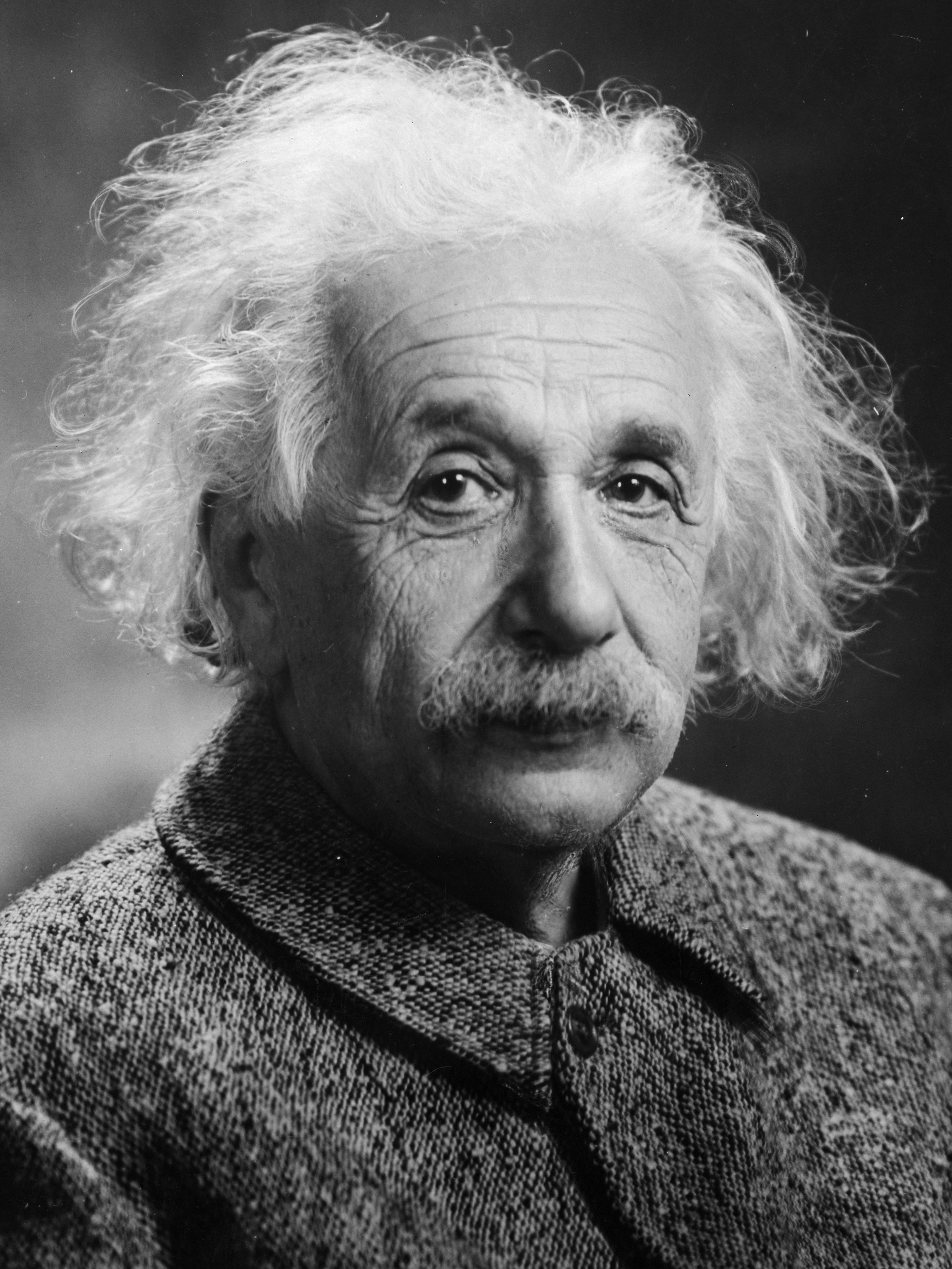
Albert Einstein
Albert Einstein was a German-born theoretical physicist who developed the theory of relativity, one of the two pillars of modern physics. His mass-energy equivalence formula E=mc² is one of the most famous equations in the world.
Why Albert Einstein Appears in the Documents
Albert Einstein is mentioned in 19 documents within the Epstein file corpus, consisting of 12 articles, 2 emails, 1 book, 1 chat, 1 education program, 1 educational program, 1 press release, originating from the House Oversight Committee.
These documents include titles such as "DeMilked - 30 Ordinary Photos With Amazing Backstories", "Debate on Cultural Evolution, Psychopathy, and Evolutionary Genetics", "Evilicious" among others. Albert Einstein's name appears across these documents in various contexts. The document corpus contains a wide range of materials including media coverage, government records, and legal proceedings where many public figures are mentioned.
Disclaimer: Appearing in the Epstein document corpus does not imply wrongdoing, guilt, or any form of association with criminal activity. Many public figures are mentioned incidentally in these documents due to the broad scope of the released materials.
Documents (19)
DeMilked - 30 Ordinary Photos With Amazing Backstories
This DeMilked digest highlights how everyday photos can carry extraordinary meaning, featuring a gallery of 30 ordinary pictures with powerful backstories—from wartime heroism and historic rescues to intimate moments of loss and triumph—alongside stories about a Chinese makeup artist who transforms herself into iconic figures, a prodigious 16-year-old Serbian artist, and a humorous series pairing ordinary Slavic people with look-alike celebrities.
Source: House Oversight Committee
DeMilked - 30 Ordinary Photos With Amazing Backstories
This DeMilked digest highlights how everyday photos can carry extraordinary meaning, featuring a gallery of 30 ordinary pictures with powerful backstories—from wartime heroism and historic rescues to intimate moments of loss and triumph—alongside stories about a Chinese makeup artist who transforms herself into iconic figures, a prodigious 16-year-old Serbian artist, and a humorous series pairing ordinary Slavic people with look-alike celebrities.
Source: House Oversight Committee
Debate on Cultural Evolution, Psychopathy, and Evolutionary Genetics
This is a heated, cross-experimental debate about what really shapes human behavior, cooperation, and conflict, arguing against a purely cultural-evolution narrative and insisting that genetic and biological processes—such as parasite pressures, kin selection, and psychopathic tendencies in leaders—remain central; the author challenges the idea that culture provides a discrete, inheritable unit of variation, criticizes cultural explanations as insufficient for explaining phenomena like language diversity, social norms, and honor killings, and presses for an integrated view that combines genetic, developmental, and cultural factors, illustrated by references to empirical work on youth psychopathy and provocative real-world examples from political and historical leaders.
Source: House Oversight Committee
Evilicious
Marc D. Hauser’s Evilicious provides a science-grounded account of why humans commit extraordinary harms: evil is not a rare defect but an incidental byproduct of a promiscuously connected brain that can fuse desire with denial, reward with punishment, and in-group loyalty with out-group hostility. Drawing on evolution, genetics, neuroscience, and social science, Hauser traces how hormones like testosterone, neurotransmitters such as dopamine and serotonin, and genes like MAOA, DRD4, and COMT shape risk, self-control, and the taste for harm, while social dynamics—dehumanization, moral disengagement, bystander effects, and large-scale cooperation—show how everyday aggression can escalate into violence, genocide, or corruption. He argues that our capacity for both great kindness and great cruelty arises from the same core architecture, and that understanding these core ingredients can illuminate moral responsibility, inform policy and law, and equip us to foster a more humane future. A compact, provocative synthesis, the book reveals evil as a predictable, learnable aspect of human nature—and urges us to confront it with science, education, and compassion.
Source: House Oversight Committee
iMessage Archive: Trump Foundation and Political Commentary (2018)
This is a June 2018 iMessage archive documenting a private, fast-paced political discussion between two correspondents, centered on the Trump Foundation investigation, commentary on Trump‑era figures (notably Steve Bannon), and related media strategy, exchange of news links, and coordinating interviews, travel, and scheduling.
Source: House Oversight Committee
iMessage Archive: Trump Foundation and Political Commentary (2018)
This is a June 2018 iMessage archive documenting a private, fast-paced political discussion between two correspondents, centered on the Trump Foundation investigation, commentary on Trump‑era figures (notably Steve Bannon), and related media strategy, exchange of news links, and coordinating interviews, travel, and scheduling.
Source: House Oversight Committee
TSS1211
Source: House Oversight Committee
TSS1211
Source: House Oversight Committee
TSS1211
Source: House Oversight Committee
TSS1211
Source: House Oversight Committee
Free Growth and Other Surprises
Gordon Getty’s Free Growth and Other Surprises argues that genuine economic growth comes not from thrift or traditional investment incentives, but from “free growth”—driven by productivity gains and the generation-to-generation transfer of total capital (human plus physical). He introduces the Y rule and the pay rule, reframes output as growth plus cash flow, and argues that human depreciation is expected to be recovered in pay even as depreciation itself rises over time. Drawing on Mill, Petty, and a new simultaneous rates method tested against market-valued capital data from Piketty and Zucman (and stock-market data), he maintains that growth at the macro scale has largely been a matter of free growth rather than savings-driven acceleration. The book then lays out sweeping policy reform: integrate human capital into national accounts, shift money toward real (inflation-adjusted) dollars, end the corporate double tax, tax capital gains like ordinary income, and split banks into deposit and lending entities so an omnibus fund can manage liquidity with low-cost derivatives. Interlacing biology and economics through Hamilton’s rule and bioeconomics, Getty frames tastes and investments as evolving under the biological imperative of lineage survival, offering a data-driven, history-grounded blueprint for a more resilient, innovation-driven economy.
Source: House Oversight Committee
Free Growth and Other Surprises
Gordon Getty’s Free Growth and Other Surprises argues that genuine economic growth comes not from thrift or traditional investment incentives, but from “free growth”—driven by productivity gains and the generation-to-generation transfer of total capital (human plus physical). He introduces the Y rule and the pay rule, reframes output as growth plus cash flow, and argues that human depreciation is expected to be recovered in pay even as depreciation itself rises over time. Drawing on Mill, Petty, and a new simultaneous rates method tested against market-valued capital data from Piketty and Zucman (and stock-market data), he maintains that growth at the macro scale has largely been a matter of free growth rather than savings-driven acceleration. The book then lays out sweeping policy reform: integrate human capital into national accounts, shift money toward real (inflation-adjusted) dollars, end the corporate double tax, tax capital gains like ordinary income, and split banks into deposit and lending entities so an omnibus fund can manage liquidity with low-cost derivatives. Interlacing biology and economics through Hamilton’s rule and bioeconomics, Getty frames tastes and investments as evolving under the biological imperative of lineage survival, offering a data-driven, history-grounded blueprint for a more resilient, innovation-driven economy.
Source: House Oversight Committee
BeliefInUnseenPowers_Book
Invisible Forces and Powerful Beliefs: Gravity, Gods, and Minds argues that humans are fundamentally social, and that unseen forces—genes, neural networks, hormones, language, empathy, and spiritual beliefs—shape our thoughts, behaviors, health, and sense of meaning. Through an interdisciplinary network, the book shows how social connection and loneliness powerfully affect physiology and cognition, how empathy and language bind minds, and how our tendency to anthropomorphize and seek higher affiliations extends from kin to groups and God. It weaves science and religious humanism to explain why cooperation, care for the vulnerable, and moral imagination have evolved, and it proposes a productive dialogue between disciplines to understand the mind, the body, and the societies we build.
Source: House Oversight Committee
Schank 1st.indd
Roger Schank argues that schools fail because they privilege subjects and memorized facts over the cognitive processes by which people think and learn; learning should be goal-directed and rooted in a core set of 12 cognitive processes (divided into conceptual, analytic, and social) learned through practice, failure, storytelling, and mentorship rather than lectures and tests. He proposes a radical redesign—story-centered, online curricula that immerse students in real-world projects guided by mentors, focusing on practicing processes such as prediction, diagnosis, planning, causation, judgment, influence, teamwork, negotiation, and describing—to cultivate genuine thinking ability and real-world skills. He critiques universities’ subject-based structures and test-driven systems, arguing for restructuring education from K‑12 to college around thinking skills, including a two-year cognitive-process foundation followed by optional specialization, or scalable online programs that deliver applicable knowledge through scenarios and simulations. The book also details how to teach each process and contends that true intelligence is the ability to diagnose, plan, and reason about causation, not simply to recall facts, urging a shift toward learning that is experiential, personalized, and aimed at helping people live thoughtfully and productively.
Source: House Oversight Committee
EDGE Annual Question 2012 Invitation (Confidential)
John Brockman circulates an invitation to prominent scientists and tech leaders to contribute to The Edge’s 2012 Annual Question, “What is your favorite deep, elegant, or beautiful explanation?”, framing it as a continuation of Freeman Dyson’s vision for a 21st‑century “Age of Wonder” at the intersection of biology and computation, and sharing submission details, deadlines, and strict editorial rules about originality, length, and tone under an embargo.
Source: House Oversight Committee
Poetry in America for Teachers II: The Poetry of Earth, Sea, and Sky
Poetry in America for Teachers II, an initiative of Harvard Graduate School of Education, HarvardX and WGBH, fuses poetry with science, environment, and the visual arts through hundreds of archival images and live footage—ranging from the Mayflower landing to Emily Dickinson’s manuscripts—and features conversations with thinkers like Michael Pollan, Al Gore, Lawrence Summers, Ray Dalio, Walter Isaacson, and Henry Louis Gates to illuminate poems by Dickinson, Whitman, Frost, and others. It delivers two classroom-ready television episodes and a fully credited middle- and high-school teacher course, with materials tested in New York and Houston through EdLabs.
Source: House Oversight Committee
Poetry in America for Teachers II: The Poetry of Earth, Sea, and Sky
Poetry in America for Teachers II is an interdisciplinary initiative from the Harvard Graduate School of Education, HarvardX and WGBH that blends the study of poetry with science, environment and the visual arts, using hundreds of archival images and on‑location footage—from oceans, forests and parks to museums and libraries—to illuminate works by Dickinson, Frost, Whitman and others; through conversations with renowned thinkers and writers such as Michael Pollan, Lawrence Summers, Al Gore, Ray Dalio, Walter Isaacson, Peter Galison and David Coleman, filmed at sites from Nantucket and the Concord River to the Harvard Natural History Museum and Frost’s cabin, the project invites teachers and students to explore poetry through history, technology, ecology and imagination, including segments on urban greenspace, evolution and language poetry.
Source: House Oversight Committee
Are the Androids Dreaming Yet?: Amazing Brain. Human Communication, Creativity & Free Will.
Source: House Oversight Committee
Poetry in America for Teachers II: The Poetry of Earth, Sea, and Sky
Poetry in America for Teachers II, an initiative of Harvard Graduate School of Education, HarvardX and WGBH, fuses poetry with science, environment, and the visual arts through hundreds of archival images and live footage—ranging from the Mayflower landing to Emily Dickinson’s manuscripts—and features conversations with thinkers like Michael Pollan, Al Gore, Lawrence Summers, Ray Dalio, Walter Isaacson, and Henry Louis Gates to illuminate poems by Dickinson, Whitman, Frost, and others. It delivers two classroom-ready television episodes and a fully credited middle- and high-school teacher course, with materials tested in New York and Houston through EdLabs.
Source: House Oversight Committee